Showing posts with label Opera vs. Broadway. Show all posts

Thursday, November 19, 2015

MSO's masterstroke

The MSO under Prof. Arturo Molina about to take a bow at last week's "Opera Vs. Broadway" at Ayala Museum.

The Manila Symphony Orchestra's masterstroke this year in attracting an ever-increasing number of followers in Metro Manila is pitting popular music fare with the classical. In its nine rush-hour concerts this year alone, we've seen them do "Bach Vs. Beatles," a concert that the MSO later brought to Baguio City along with "Soundtracks and Symphonies" as part of its Music Everywhere outreach program.

Even with a serious program like July's "Transfigured Night" (music by Schoenberg), the program never failed to engage. Always there is an educational component--a conductor or MSO official faces the audience to give the context of the music. After all, to continue to exist in this generation of millennials, the MSO has to use the media the kids are used to for social marketing (Facebook, Twitter, Instagram, Mailchimp) and for staging (attractive PowerPoint presentations projected in the background).

Each concert is entertainingly annotated by Jeffrey Solares, the orchestra's executive director, who knows his audience's kaliti by making references to popular figures or ideas in a manner and a language that are also pop. He banishes all notions that classical music is only for the elite and the erudite. He encourages more people to attend live performances instead of settling for YouTube or recordings because of the elements of excitement and unpredictability, saying, "Lots of things can happen--a voice can croak, strings can break..."

He defines opera as a musical art form that emulates Greek theater and formed by poets, philosophers and musicians who had studied Greek drama. To open last week's program of "Marriage of Figaro," the MSO played Mozart's "Overture to Marriage of Figaro," an opera that Solares describes as controversial during its time in the last 1700s because it dared to poke fun at the dukes, duchesses and other members of the royalty and it was from the point of view of the servants.

Michaela Fajardo, soprano with a creamy voice

What made the concert doubly special was the participation of some members of the country's premier vocal ensemble, Viva Voce. Soprano Michaela Fajardo surprised us immediately with the aria "Voi Che Sapete" or "Tell Me What Love Is." It's a textured voice--high and deep, if that were possible. Plus it had volume that could extend up to the back row of the capacity crowd. Impresario Joseph Uy, if he had been there, would've described the voice's quality as "creamy" to mean a pure lyric voice.

Carlo Mañalac may look skinny and fragile for a tenor but his voice has power.

Solares disclosed that Fajardo was his violin student for four years. When she wasn't turning up for lessons anymore, he was happily surprised to learn that she had shifted to voice as her major. Young, fresh-faced tenor Carlo Mañalac showed a nervous quiver in his voice in the initial notes and lyrics of Donizetti's romanza, "Una Furtiva Lagrima" from the opera L'elesir di amore. Solares noted how operas are all bound by one theme: love or doomed love.

Our favorite aria was sung: Musetta's aria "Quando Me En Vo" from Puccini's La Boheme with soprano Iona Ventocilla proving that she can alternate the roles of the suffering seamstress Mimi and the coquettish Musetta. (By the way, the chamber version of La Boheme will be restaged by Viva Voce on Nov. 26 at Ayala Museum after the acclaimed summer presentation of the well-loved opera at Baguio's Hill Station. Last Tuesday's museum audience had a glimpse of the dramatic dynamics and singing of Ventoncilla as Mimi and Mañalac as Rodolfo in their duet "O Soave Fanciula.")

The rush-hour concerts, meant to draw Makati's young professionals so they can skip the after-5 p.m. traffic, are short enough not to require an intermission, but the MSO instead played the sweetly melodious intermezzo from "Cavalleria Rusticana" that had the audience heave a collective sigh at the end. For this alone our evening was made.

There was, of course, the accession to popular fare: overtures from My Fair Lady and Westside Story, songs from Phantom of the Opera, Jekyll and Hyde where tenor Carlo Falcis proved he could be a belter in reality TV shows cum singing competitions, Rent and Les Miserables. For an encore, the MSO obliged with the overture from Chicago.

I confess to being biased. When the classics face off with pop, the classics win by a knockout.

Wednesday, April 11, 2012

“Opera vs. Broadway” for Sendong’s survivors

LISTENING to a mishmash of operatic arias and Broadway hits, as though an iPod shuffle was being executed as a “sensurround” experience, is a lovely way to spend an evening. It turns lovelier because this one happened on a Monday, unexpectedly and pleasantly jump-starting a week of hard work.

When visiting Hong Kong baritone Wayne Yeh and the Philippines’ Lissa Romero de Guia, with dependable piano accompanist Mary Anne Espina, engaged in a mock battle called “Opera vs. Broadway,” it was in the name of philanthropy. EDSA Shangri-La Hotel offered its capacious Isla Ballroom rent-free for this benefit concert for Typhoon Sendong survivors.

Yeh and de Guia are volunteers of the Art of Living Foundation, a non-government organization (NGO) that continues to give trauma relief to adult and child survivors of the disaster in Cagayan de Oro and Iligan cities. The foundation has 145 chapters worldwide with the Philippine chapter involved in helping rehabilitate Bilibid prison inmates and survivors of super-typhoons.

Denise Celdran, the foundation’s breath works instructor, said what sets this NGO’s work apart is its focus on removing stress and negative emotions through simple breathing, sound meditation techniques and yoga stretches. An audio-visual presentation before the concert showed how the survivors became calm and more optimistic after they learned these exercises in the tent cities or basketball courts.

She added that these exercises put smiles back on people’s faces and peace in their minds, enabling them to function better and relish donated food, clothes and temporary shelter.  Celdran pointed out how many thousands more need to be reached and empowered.
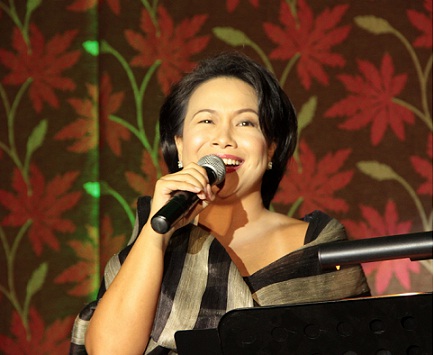
 LISSA ROMERO DE GUIA
 Thus, what de Guia called “a ping pong between opera and Broadway” was thought up to raise more funds for volunteers who will help restart other lives.

A sidelight was a silent auction for the same cause featuring works donated by these visual artists: Tosha and Gus  Albor, Wesley Valenzuela, Stephanie Lopez, Felix Bacolor, Kidlat and Kabunyan de Guia, Oliver Olivete and Marisa Romero.

Observing how people get mired in past traumas and worry unnecessarily about the future, Celdran said the foundation teaches people “to be in the present, to be in the moment” so they could them live “artfully, gracefully, peacefully.”

She said these are possible by learning how to manage the mind, emotions, stored memories, intellect that passes judgment, ego that expresses and processes bad memories. This management of all layers of experience, she said, leads to a self that can contribute to improving society.
 WAYNE YEH
Lanky baritone Yeh, whose credits include singing as a lad before Dame Kiri Te Kanawa and appearing in Opera Hong Kong’s productions of Turandot, Mozart’s Requiem, Carmen, among others, continues to train with voice coaches Rita Patane and Pietro Spagnoli in Milan, Italy. That night, he entered from the back of the ballroom, clad in black tuxedo and pants, white bowtie and dark glasses. He held a cordless mic and warbled “Figaro” from The Barber of Seville while shaking hands with some members of the audience.

The rest of the evening he alternated use of the center stage with de Guia. Her theater experience includes being in the original German cast of Miss Saigon in Stuttgart, the Narrator in the original German cast of Joseph and the Amazing Technicolor Dreamcoat (the first Filipina to play that role on the international stage), and playing Gigi in Miss Saigon, United Kingdom tour.

Semi-retired from theater after going into writing, she showed that she still had “it,” a wide vocal range. She moved from alto in South Pacific’s “Bali Hai” to middle range and to a belter of a soprano in “Home” from The Wiz.

She displayed her acting chops without a costume change. In her black and gray long dress with a panuelo top, she was a flirt in “I Enjoy Being a Girl” from Flower Drum Song, a besotted Eliza in “I Could Have Danced All Night” from My Fair Lady, a tragic Eponine in “On My Own” from Les Miserables, a noble woman in “Something Wonderful,” a wistful illicit lover in the medley “I Have Dreamed” and “We Kiss in a Shadow” from The King and I, which she reprised with Yeh in a duet after an earlier song on one-upmanship with him, Berlin’s “Anything You Can Do I Can Do Better” from Annie Get Your Gun.

The practice of breath work enabled de Guia to hold notes far longer than possible. This had a heavily partial audience cheering for her. Similarly, Yeh tried to match her with his solos of “Our Father,” “Ave Maria,” “You Raise Me Up” and encores (“O Sole Mio” and “Santa Lucia”).

Inspirational teacher Sri Ravi Shankar defined music as “sound in harmony, silence in clarity.” That night, silence and sound came together without clashing.--Elizabeth Lolarga

First published by Vera Files/Yahoo Philippines, March 31, 2012
Photos by  RONALD VERZO