Pianist Noriko Ogawa with a young Filipino admirer Photos by Amado Chua
How does one become a specialist in the music of Claude Debussy? He doesn’t seem to be the warhorse kind of composer the way Beethoven, Mozart, Chopin, Liszt are.
But to Noriko Ogawa, 54, a Steinway artist who visited Manila recently for an exclusive concert and a lecture-recital open at the Santiago Hall of the BDO Corporate Center in Makati, she knew Debussy was “it” for her when she first saw someone performing his music on TV.
“That was the beginning,” she said. “My teacher didn’t let me study Debussy, saying he was for weak fingers and that I wouldn’t develop well. So I became a secret Debussy player. My mother would be upset, to put it mildly, if I practice something not in my lessons.”
She used to sneak out to go to a music store. There she’d play Debussy pieces on a piano until she estimated that her absence would be noticed by her mother, then she’d return home. She recalled, “The pressure from my parents was incredibly great. It was very suffocating for me, but now I’m grateful to them. I can just cry thinking of them.”
She was something of a “wild child” but one who never forgot to practice her piano until the day came in her teens when her teacher told her she needed to speak to her parents. At the time, she played on a Yamaha. Nervous and all wrought up before the teacher-parent meeting, she overheard the teacher say, “Your child needs a better instrument like a Steinway.”
Being macho, her stoic father, replied, “I’ll get her one.” Her mother, although a piano teacher, was against the idea or maybe thought the family couldn’t afford a Steinway. The father kept his word, telling his daughter, “This is the last thing I’ll buy you.” Ogawa laughed, “Which is true!”
Ogawa went on to win the Leeds International Piano Competition. The Telegraph described her performance as “ravishingly poetic playing.” She is also the translator of Susan Tomes’s book Out of Silence, a pianist’s yearbook that has been reprinted several times. After the tsunami in Japan in 2011, she raised over €40,000 for the British Red Cross Japan Tsunami Fund. She is the founder of Jamie’s Concerts, a series for autistic children and parents, and cultural ambassador of the National Autistic Society.
With piano prodigy Hansel Ang
She is a credible and animated storyteller on her subject’s life. She narrated how Debussy was born to poor parents (his father’s porcelain business was unsuccessful) whose recourse for their children to survive was to farm them out to aunts and uncles to be raised.
Debussy grew not wanting to talk about his childhood. But as a child there was money for piano lessons. His talent was recognized. At age 10 he was admitted to the Paris Conservatoire which had “extremely high standards,” Ogawa said, “and this showed how talented he was.”
But his parents couldn’t understand or appreciate this, expecting the conservatory to be a regular school that would teach their son spelling, arithmetic and the like. Because Debussy’s primary education, particularly his arithmetic, wasn’t good, his music manuscripts have a lot of human errors. Nevertheless, he was good at sight reading, dictation and singing notes and was an “amazing piano accompanist who won plum prizes. His musicality flourished in Paris.”
The Frenchman admired Chopin and, like him, wrote ballades, mazurkas, etudes and preludes. Although he also respected the techniques in German piano tradition, Debussy, being French, “wanted beautiful things like clarity and simplicity,” Ogawa said. “He decided his music would float in the air and express more natural incidents of life.”
This was Impressionism in music. “Impressionism,” however, is not a positive word for many. Ogawa was taught this, and she wondered, “What’s wrong with it?”
She told the students in the audience, “We piano teachers know when you copy. You have to look at the music carefully. It has to come from you, not from YouTube. You can’t come from an impression—that’s the negative way.”
She narrated how Debussy entered many composition contests but didn’t win much so he concentrated on writing. Among his early pieces was “Clair de Lune” which Ogawa performed. Later, she said, “I recommend you learn this to use as an encore or to play at a party or a recital. It’s a very useful piece. The movement in the middle has beautiful tones. It requires a good instrument.”
Through this and other pieces, Debussy established his impressionist style which he preferred to call symbolist. When he saw the 1889 Paris World Exposition, he was so impressed with Asian music that he gave the “impression” of it in his “Pagode.”
Ogawa said, “Although he wasn’t able to go to Asia, based on the gamelan music, he was able to capture the hot, steamy air of the tropics.”
Sadly, she noted, all that Debussy wrote were “miniature pieces. He didn’t write a sonata for the piano, no half-hour long pieces like Liszt and Brahms did.”
Watercolorist Amado Chua's impressions of the Japanese pianist
To her studying and practicing Debussy is “about the beauty of the sound, not about Debussy or his relationships though he had dramatic ones. I look at the music and get directly the messages from the piano, not from something romantic. This is not about Debussy falling in love with a girl. ‘Clair de Lune’ is about the moon. Look at the music he put down, all the things he wants us to do. His music makes us imagine scenery, but for me the sound comes first, then the images of water come in.”-- Elizabeth Lolarga
This article appeared in a shortened version in today's issue of the Philippine Daily Inquirer Arts and Books section.
Showing posts with label Philippine Daily Inquirer. Show all posts
Monday, March 6, 2017
Thursday, December 29, 2016
Consoling feedback after 'Yuletide without Mom'
My essay "Yuletide without Mom" came out in yesterday's Highblood section of the Philippine Daily Inquirer. I received feedback in my email and in text messages. Some friends who I haven't been in touch with in awhile were surprised to learn Mom had passed away. I also learned of recent deaths in their families.
First to respond was my kumpare (godfather to my youngest daughter Ida), the writer Amadis Ma. Guerrero. He texted early yesterday: "A moving tribute to Mommy Lolarga was we at Raya (our former office) called her. She was our Mommy, too!"
From painter-actor Ivi Avellana Cosio (daughter of National Artists Lamberto and Daisy Avellana) came a longer message that cried to be shared with those who are grieving: "My dearest Babeth, our deepest condolences on your Mom's passing. A special hug for you and your youngest sister with whom I truly empathize. My Mom passed way (also in May) of 2013 on Mother's Day, a few days before my birthday. In December, my older daughter insisted we celebrate the first Christmas without Mama in Beijing with her and her family. It was so different that it helped to get us through such a painful time. But back in Manila, same same. I still cry when I think of her, or my Papa who left us in 1991, or my favorite brother in 2011, or my grandparents who passed away when I was much much younger. Grief is really so personal and different for each one. And I truly believe no one has a right to tell you how, when, or how long to grieve. Also, no such thing as 'getting over it'. You don't, well-meaning friends notwithstanding. You just learn how to cope with it one day at a time. And there will be good days and bad days. That being said, I wish you and yours a better New Year in every way. Tama si Helen Mirren. Much love from us."
Smiling grandmother with grandchildren Ida and Kimi Fernandez and Carlo Trinidad (foreground) several Christmases ago
“Would you rather I clean the house or write a poem? A poem lasts.”—my Mom
“I want to write poems instead of notes, but each ending is a death,
and I cannot handle the finish of words.”—Renée E. D’Aoust in her essay “Gratitude is my Terrain: Maybe”
This time of the year last year, she had just been discharged after a prolonged hospital stay. There was no exact term for what was ailing her, but it was enough for my siblings and me to have her home for the holidays. She missed reunion parties with her amigas and favorite nephew. We thought she would rally and recover in the new year.
But as actor Helen Mirren put it succinctly in summarizing the year 2016, “I think we can all agree that 2016 has been a big pile of sh*t.” It was the year when Mom’s worst fears about the betrayal of her body came true. We, along with hired caregivers, took turns cleaning her up after a “lapse.” Never could I erase from memory the helpless, pained look on Mom’s face every time this happened. I could sense that to her it was the ultimate humbling, and her look carried an apology with it.
Even if I tried to humor her when I tidied her up, the smile that used to light up our house was gone. That smile was the most eulogized part of her on the last day of her wake. Writer Efren Yambot told of how he was welcomed to the small feasts Mom prepared for her Manila Bankers Life colleagues by her smile. It encouraged him to return to similar occasions she hosted even if it meant covering miles to get to the office. When my Singapore-based daughter Ida would come home, it was Mom’s smile that greeted her first.
This Christmas my husband ordered chicken galantina from two sources to replace the irreplaceable—Mom’s yearly supply of morcon. He once had a meal at a restaurant in San Fernando, Pampanga, that boasted of the best morcon. He even had a beef roulade wrapped to take home. But his verdict was it was close to the taste of dog food and couldn’t approximate Mom’s morcon.
His assistant then, a recipient of Mom’s largesse, used to say that even only the sauce of the morcon sufficed for a meal. That was how good it was: We would ladle leftover sauce on a steaming mound of white rice when the meat roll was gone. Nothing was wasted.
A sister and some cousins were able to observe Mom in the act of preparing morcon, but even if it is ever replicated, the matriarch-cook who ruled over the kitchen and the rest of our house isn’t there to pronounce judgment on another’s take on her dish.
Mom with her five daughters
It isn’t just her dishes that we miss. Nightly the youngest of my four sisters weeps from the pain of the loss. Recently, she suffered chest constrictions and had to take herself to the hospital emergency room because of the stress of prolonged grieving (Mom died last May). Despite our assurances to her that Mom is at peace, she still isn’t prepared to go to the next level of the stages of grief and loss according to Elizabeth Kubler Ross (denial, anger, bargaining, depression and acceptance). Grief counseling has been advised, but it is up to her if she will take it.
To sort of pierce through the cloud of sorrow hovering over the house, I right away volunteered to host Christmas carolers from my Grade 11 class. The sound of young voices, the guitar strummed by a fellow teacher, makeshift maracas and drums brought the tidings of comfort and joy straight to our hearts.
Although my sisters and I didn’t prepare anything homemade from our kitchen (we cannot hold a candle to our mother, cooking-wise), the store-bought pancit, roast chicken and mini siopao were wiped out by bottomless adolescent appetites. I truly felt Mom’s spirit approving.
To those having a hard time coping with the holiday frenzy because of mourning that cannot be kept at bay, keep saying “This, too, shall pass” and leave some space for the occasional joy to surprise you.
First to respond was my kumpare (godfather to my youngest daughter Ida), the writer Amadis Ma. Guerrero. He texted early yesterday: "A moving tribute to Mommy Lolarga was we at Raya (our former office) called her. She was our Mommy, too!"
From painter-actor Ivi Avellana Cosio (daughter of National Artists Lamberto and Daisy Avellana) came a longer message that cried to be shared with those who are grieving: "My dearest Babeth, our deepest condolences on your Mom's passing. A special hug for you and your youngest sister with whom I truly empathize. My Mom passed way (also in May) of 2013 on Mother's Day, a few days before my birthday. In December, my older daughter insisted we celebrate the first Christmas without Mama in Beijing with her and her family. It was so different that it helped to get us through such a painful time. But back in Manila, same same. I still cry when I think of her, or my Papa who left us in 1991, or my favorite brother in 2011, or my grandparents who passed away when I was much much younger. Grief is really so personal and different for each one. And I truly believe no one has a right to tell you how, when, or how long to grieve. Also, no such thing as 'getting over it'. You don't, well-meaning friends notwithstanding. You just learn how to cope with it one day at a time. And there will be good days and bad days. That being said, I wish you and yours a better New Year in every way. Tama si Helen Mirren. Much love from us."
Smiling grandmother with grandchildren Ida and Kimi Fernandez and Carlo Trinidad (foreground) several Christmases ago
“Would you rather I clean the house or write a poem? A poem lasts.”—my Mom
“I want to write poems instead of notes, but each ending is a death,
and I cannot handle the finish of words.”—Renée E. D’Aoust in her essay “Gratitude is my Terrain: Maybe”
This time of the year last year, she had just been discharged after a prolonged hospital stay. There was no exact term for what was ailing her, but it was enough for my siblings and me to have her home for the holidays. She missed reunion parties with her amigas and favorite nephew. We thought she would rally and recover in the new year.
But as actor Helen Mirren put it succinctly in summarizing the year 2016, “I think we can all agree that 2016 has been a big pile of sh*t.” It was the year when Mom’s worst fears about the betrayal of her body came true. We, along with hired caregivers, took turns cleaning her up after a “lapse.” Never could I erase from memory the helpless, pained look on Mom’s face every time this happened. I could sense that to her it was the ultimate humbling, and her look carried an apology with it.
Even if I tried to humor her when I tidied her up, the smile that used to light up our house was gone. That smile was the most eulogized part of her on the last day of her wake. Writer Efren Yambot told of how he was welcomed to the small feasts Mom prepared for her Manila Bankers Life colleagues by her smile. It encouraged him to return to similar occasions she hosted even if it meant covering miles to get to the office. When my Singapore-based daughter Ida would come home, it was Mom’s smile that greeted her first.
This Christmas my husband ordered chicken galantina from two sources to replace the irreplaceable—Mom’s yearly supply of morcon. He once had a meal at a restaurant in San Fernando, Pampanga, that boasted of the best morcon. He even had a beef roulade wrapped to take home. But his verdict was it was close to the taste of dog food and couldn’t approximate Mom’s morcon.
His assistant then, a recipient of Mom’s largesse, used to say that even only the sauce of the morcon sufficed for a meal. That was how good it was: We would ladle leftover sauce on a steaming mound of white rice when the meat roll was gone. Nothing was wasted.
A sister and some cousins were able to observe Mom in the act of preparing morcon, but even if it is ever replicated, the matriarch-cook who ruled over the kitchen and the rest of our house isn’t there to pronounce judgment on another’s take on her dish.
Mom with her five daughters
It isn’t just her dishes that we miss. Nightly the youngest of my four sisters weeps from the pain of the loss. Recently, she suffered chest constrictions and had to take herself to the hospital emergency room because of the stress of prolonged grieving (Mom died last May). Despite our assurances to her that Mom is at peace, she still isn’t prepared to go to the next level of the stages of grief and loss according to Elizabeth Kubler Ross (denial, anger, bargaining, depression and acceptance). Grief counseling has been advised, but it is up to her if she will take it.
To sort of pierce through the cloud of sorrow hovering over the house, I right away volunteered to host Christmas carolers from my Grade 11 class. The sound of young voices, the guitar strummed by a fellow teacher, makeshift maracas and drums brought the tidings of comfort and joy straight to our hearts.
Although my sisters and I didn’t prepare anything homemade from our kitchen (we cannot hold a candle to our mother, cooking-wise), the store-bought pancit, roast chicken and mini siopao were wiped out by bottomless adolescent appetites. I truly felt Mom’s spirit approving.
To those having a hard time coping with the holiday frenzy because of mourning that cannot be kept at bay, keep saying “This, too, shall pass” and leave some space for the occasional joy to surprise you.
Thursday, August 4, 2016
Arca's Yard and its camote pie
A row of bulols (rice granary gods) found in the attic of Arca's Yard Photos by EV ESPIRITU
Come rain or come shine, Arca’s Yard up in Tiptop, the boundary of Baguio and La Trinidad along Ambuklao Road, enjoys full-house patronage. Locals don’t mind the drive up outside city limits to get their slice of camote pie.
Owner Nida “Ninj” Sabado believes “I’m the only one serving this pie probably in the whole Philippines.” She cites the root crop’s role in Igorot rituals, especially in cañaos where pigs or carabaos are butchered to mark special occasions like wedding feasts. Alongside the cooked meat, staples like camote and gabi are served,
Sabado grew tired of boiled camote so she thought of a different way of serving it. She researched and discovered that sweet potato pie is the favorite dessert of Michael Jackson. Through trial and error, she got the taste she liked—pure, organic, with loads of anti-wrinkle and anti-oxidant elements.
Camote pie a la mode
Before Arca’s Yard Café opened, there was the gallery she put up to assuage her grief over her mother’s death in 2014. It was a combination of mini library and museum with the Cordillera as its theme. She said, I want to share and preserve the culture of Benguet and the whole Cordillera.”
She wanted the place to be somewhere her writer and artist friends could hang out, even if there was a typhoon raging. The gallery once faced the road, then she moved it to their adjacent family proper and now it’s facing three mountains on a clear day: Mt. Pulag’s tip, Mt. Purgatory and Mt. Ugo on the Itogon side. The sunrise and full moon can be viewed from the balcony.
The gallery-café grew to a three-room bread and breakfast place that is five storeys high, including an attic for the book collection, and still expanding sideways. It has come a long way from being originally the ranch and kamote plot of Sabado’s father Arca. She says he had no surname—Jonson, Dianson, Djanson were appended after his first name. Before World War II, Arca supplied Camp John Hay and the hotels of Baguio with fresh milk.
Ninj Sabado is a good storyteller about the old Baguio.
Today Sabado’s customers not only go up for the pie but also for the enlanrged menu that includes lamb chops, pasta, lechon kawali, arroz a la cubana and anything that she calls “easy and quick to cook. I didn’t realize all this would be successful.”
Arca’s popularity grew through word of mouth and social media. Visitors are always fighting over seats that have panoramic views whether it’s sunny, rainy or foggy.
Lovers' Locks
Another feature is gate inspired by a bridge in Paris. Sabado calls it Lovers’ Lock. She sells the padlocks for a minimal fee and lovers can make their vows by that gate barring a cliff.
When the restaurant is packed, service slows down. Sabado soothes her waiting customers, telling them, “We’re new, we’re feeling our way and trying to improve the service.” –Elizabeth Lolarga
View from the balcony
This article and some photos were first published in the Aug. 3, 2016, issue of the Philippine Daily Inquirer Northern Luzon Supplement.
Come rain or come shine, Arca’s Yard up in Tiptop, the boundary of Baguio and La Trinidad along Ambuklao Road, enjoys full-house patronage. Locals don’t mind the drive up outside city limits to get their slice of camote pie.
Owner Nida “Ninj” Sabado believes “I’m the only one serving this pie probably in the whole Philippines.” She cites the root crop’s role in Igorot rituals, especially in cañaos where pigs or carabaos are butchered to mark special occasions like wedding feasts. Alongside the cooked meat, staples like camote and gabi are served,
Sabado grew tired of boiled camote so she thought of a different way of serving it. She researched and discovered that sweet potato pie is the favorite dessert of Michael Jackson. Through trial and error, she got the taste she liked—pure, organic, with loads of anti-wrinkle and anti-oxidant elements.
Camote pie a la mode
Before Arca’s Yard Café opened, there was the gallery she put up to assuage her grief over her mother’s death in 2014. It was a combination of mini library and museum with the Cordillera as its theme. She said, I want to share and preserve the culture of Benguet and the whole Cordillera.”
She wanted the place to be somewhere her writer and artist friends could hang out, even if there was a typhoon raging. The gallery once faced the road, then she moved it to their adjacent family proper and now it’s facing three mountains on a clear day: Mt. Pulag’s tip, Mt. Purgatory and Mt. Ugo on the Itogon side. The sunrise and full moon can be viewed from the balcony.
The gallery-café grew to a three-room bread and breakfast place that is five storeys high, including an attic for the book collection, and still expanding sideways. It has come a long way from being originally the ranch and kamote plot of Sabado’s father Arca. She says he had no surname—Jonson, Dianson, Djanson were appended after his first name. Before World War II, Arca supplied Camp John Hay and the hotels of Baguio with fresh milk.
Ninj Sabado is a good storyteller about the old Baguio.
Today Sabado’s customers not only go up for the pie but also for the enlanrged menu that includes lamb chops, pasta, lechon kawali, arroz a la cubana and anything that she calls “easy and quick to cook. I didn’t realize all this would be successful.”
Arca’s popularity grew through word of mouth and social media. Visitors are always fighting over seats that have panoramic views whether it’s sunny, rainy or foggy.
Lovers' Locks
Another feature is gate inspired by a bridge in Paris. Sabado calls it Lovers’ Lock. She sells the padlocks for a minimal fee and lovers can make their vows by that gate barring a cliff.
When the restaurant is packed, service slows down. Sabado soothes her waiting customers, telling them, “We’re new, we’re feeling our way and trying to improve the service.” –Elizabeth Lolarga
View from the balcony
This article and some photos were first published in the Aug. 3, 2016, issue of the Philippine Daily Inquirer Northern Luzon Supplement.
Monday, June 13, 2016
Anne Marie of the keys
Anne Marie "Macky" Caldoza
“Good music, good food”—these, in pianist Anne Marie Caldoza’s words, are her priorities in life as she enters her 25th year on earth, half of it spent studying her instrument.
Known to family and friends as Macky, she attributes to her Lola Joaquinita her first exposure to music. Joaquinita Cinco Alzate was the town pianist. During the Japanese period, she played for parties. She even accompanied a young Imelda Romualdez in Tacloban. But Caldoza said her attention span as a child was such that she couldn’t learn earnestly from her lola. Or she may have tried the older woman’s patience.
At age 12 she began formal piano studies with Prof. Najib Ismail at the University of Santo Tomas. During that period with him she won, among many prizes, honorable mention from the National Music Competition for Young Artists in 2013, a silver award from the 2011 Asia International Piano Academy and Festival with Competition in Korea, second prize the 2010 UST Chopin Competition, second prize from the 2007 Piano Teachers Guild of the Philippines Bach Competition.
After she graduated cum laude at the UST Conservatoryof Music with a bachelor of music in piano performance and performing at Paco Park, Ismail thought she was fit for something bigger and recommended her to pursue her masters of music in piano performance at the Longy School of Music of Bard College in Cambridge, Massachusetts.
To reach Longy, a century-old conservatory inside a New England mansion, one of the largest in Boston, she walks for 30 minutes, cutting through Cambridge Commons and Harvard Square from the house where she rents a room from a Filipino family.
Calzado has built a name for herself on campus, having served as an officer of the Longy Student Association in her first year and co-president in her second. Longy has a small student population of 250. She says they know one another, adding, “Basically, we are one big crazy family.”
She recently graduated but plans to return to Longy this fall for a graduate performance diploma, saying, “I still have lots to work on.” She adds that two years of graduate studies aren’t enough and despite four hours of daily practice.
If there’s anything that Longy has taught her, she says, “It is to embrace all possibilities and to think creatively as possible, be it in class projects, concert programming, performance practice, etc. The dream is to make a difference, no matter how small.”
Caldoza opens the Manila Chamber Orchestra Foundation (MCOF) season on June 22 at 7 p.m. at Ayala Museum with a challenging program made up of Handel’s “Suite in B-flat Major, HWV 440,” Beethoven’s “Sonata in E-flat Major, op. 7,” Haydn’s “Sonata in G Major Hob. XVI: 40,” Harold Shapero’s “Sonata in D Major” and Rachmaninoff’s “Etudes-Tableaux, op. 33.”
She says of her selections: “There’s always something to love about the style of each composer. I play or listen according to my mood as part of my ‘quarter-life crisis.’ Even if Handel is baroque, there is something lyrical you can do with him. You’re allowed a little freedom because the counterpoint is very thin. I have friends who study early music, and they’ve helped me with nuances.”
To relax she continues the family tradition of baking. She specializes in cupcakes and cookies for her own consumption and for community sharing. Her latest creations carry the combined flavors of Earl Grey tea and chocolate, chocolate crinkles with a crusty top and ginger molasses cookies.
Or she plays with four dogs, two of them pugs. Caldoza talks fondly of them, “We’ve had Raya since I was in high school. The other is Porkchop, a fairly recent addition. Raya sleeps under my piano whenever I practice. I used to have a pug named Puffy that loved the Grieg minor concerto and she’d come running when she hears me start playing. She’d sit beside me for hours and sometimes howl while I played.” -- Elizabeth Lolarga
For tickets to Caldoza’s “Tribute to the Masters,” call Ticketworld at 891-9999 or MCOF at 997-9483, 782-7164 or cell phone nos. 0920-954-0053 and 0918-347- 3027.
A shorter version of this article is published in today's issue of the Philippine Daily Inquirer's Arts and Books section.
“Good music, good food”—these, in pianist Anne Marie Caldoza’s words, are her priorities in life as she enters her 25th year on earth, half of it spent studying her instrument.
Known to family and friends as Macky, she attributes to her Lola Joaquinita her first exposure to music. Joaquinita Cinco Alzate was the town pianist. During the Japanese period, she played for parties. She even accompanied a young Imelda Romualdez in Tacloban. But Caldoza said her attention span as a child was such that she couldn’t learn earnestly from her lola. Or she may have tried the older woman’s patience.
At age 12 she began formal piano studies with Prof. Najib Ismail at the University of Santo Tomas. During that period with him she won, among many prizes, honorable mention from the National Music Competition for Young Artists in 2013, a silver award from the 2011 Asia International Piano Academy and Festival with Competition in Korea, second prize the 2010 UST Chopin Competition, second prize from the 2007 Piano Teachers Guild of the Philippines Bach Competition.
After she graduated cum laude at the UST Conservatoryof Music with a bachelor of music in piano performance and performing at Paco Park, Ismail thought she was fit for something bigger and recommended her to pursue her masters of music in piano performance at the Longy School of Music of Bard College in Cambridge, Massachusetts.
To reach Longy, a century-old conservatory inside a New England mansion, one of the largest in Boston, she walks for 30 minutes, cutting through Cambridge Commons and Harvard Square from the house where she rents a room from a Filipino family.
Calzado has built a name for herself on campus, having served as an officer of the Longy Student Association in her first year and co-president in her second. Longy has a small student population of 250. She says they know one another, adding, “Basically, we are one big crazy family.”
She recently graduated but plans to return to Longy this fall for a graduate performance diploma, saying, “I still have lots to work on.” She adds that two years of graduate studies aren’t enough and despite four hours of daily practice.
If there’s anything that Longy has taught her, she says, “It is to embrace all possibilities and to think creatively as possible, be it in class projects, concert programming, performance practice, etc. The dream is to make a difference, no matter how small.”
Caldoza opens the Manila Chamber Orchestra Foundation (MCOF) season on June 22 at 7 p.m. at Ayala Museum with a challenging program made up of Handel’s “Suite in B-flat Major, HWV 440,” Beethoven’s “Sonata in E-flat Major, op. 7,” Haydn’s “Sonata in G Major Hob. XVI: 40,” Harold Shapero’s “Sonata in D Major” and Rachmaninoff’s “Etudes-Tableaux, op. 33.”
She says of her selections: “There’s always something to love about the style of each composer. I play or listen according to my mood as part of my ‘quarter-life crisis.’ Even if Handel is baroque, there is something lyrical you can do with him. You’re allowed a little freedom because the counterpoint is very thin. I have friends who study early music, and they’ve helped me with nuances.”
To relax she continues the family tradition of baking. She specializes in cupcakes and cookies for her own consumption and for community sharing. Her latest creations carry the combined flavors of Earl Grey tea and chocolate, chocolate crinkles with a crusty top and ginger molasses cookies.
Or she plays with four dogs, two of them pugs. Caldoza talks fondly of them, “We’ve had Raya since I was in high school. The other is Porkchop, a fairly recent addition. Raya sleeps under my piano whenever I practice. I used to have a pug named Puffy that loved the Grieg minor concerto and she’d come running when she hears me start playing. She’d sit beside me for hours and sometimes howl while I played.” -- Elizabeth Lolarga
For tickets to Caldoza’s “Tribute to the Masters,” call Ticketworld at 891-9999 or MCOF at 997-9483, 782-7164 or cell phone nos. 0920-954-0053 and 0918-347- 3027.
A shorter version of this article is published in today's issue of the Philippine Daily Inquirer's Arts and Books section.
Monday, May 30, 2016
The music never stops for this couple
Soprano Stefanie Quintin and classical guitarist Anton Luis Avila have been sweethearts since their high school years in Baguio City. The way the romance began depends on who’s telling the story.
Avila said they met during the National Music Competition for Young Artists in 2005. “I was competing in the Category B Guitar Competition. She was part of her school choir for the Category B Choral Competition. It's a long story from there, but that’s how Stef first fell for me.”
Quintin protested, “I did not notice Anton back then until my friends started having a big crush on him. Having a crush on a guitarist was inevitable. So there, we became high school sweethearts and eventually became colleagues. We have been performing together since 2007.”
The two plan to make their chemistry evident on June 5 in “Acoustic Adagietto,” a dinner concert production of the Cultural Arts Events Organizer (CAEO) as part of the Baguio Summer Music Festival at Hill Station on Upper Session Road, Baguio City. Dinner starts at 6 p.m., concert at 8 p.m.
Quintin, with Avila as accompanist, will also give a free lecture-demo-cum-mini recital on June 4 on “The Miracle of the Human Voice” at 3 p.m. at Sarmiento Hall, the alumni center of the University of the Philippines Baguio.
Stefanie Quintin
Quintin has degrees in vocal pedagogy and vocal performance from the University of the Philippines. She trained with Fides Cuyugan Asensio and Rica Nepomuceno.
She said, “I was fortunate to have The Fides as my teacher. When I entered the UP College of Music in 2008, I had no idea who she was until my batchmates told me that Tita Fides is one of the pillars of classical music here in the country. How naive of me.”
She described her teacher’s teaching style: “She lets her students explore their own capacity as singers and musicians. She gave me the freedom to choose my pieces and at the same time assigned challenging ones like Darius Milhaud’s ‘Chansons de Ronsard,’ Strauss’ ‘Madchenblumen,’ most of which are rarely performed here.”
She said Asensio’s influence on her could be seen in her selection of “rarely heard pieces,” she said. “I expand my repertoire and at the same time make the audience appreciate various compositional styles. Tita Fides taught me that singing is not just about high notes. Singing should be about the message of the music, how we can transmit it to our audience. The best thing that I learned from her is to always sing with intention, never sing for attention.”
After earning his degree in applied mathematics from the Ateneo, Avila studied guitar at UP under another legend, Lester Demetillo. The young man said, “I’ve learned a lot from him both in playing the guitar and in life. The most interesting would be these: Be creative in solving technical problems; always play musically, artistically and intelligently; and at a certain point, speed is detrimental to musicality.”
Anton Luis Avila
He found a corporate job, but, he said, “The cyclical life in the corporate setting drained me. So my dream of studying music came knocking again.”
After he convinced his parents for support, he entered the UP College of Music as a student. He said, “I was relatively successful as a guitarist during my stint there. There were realities to accept. I wanted to stay but after discerning, I realized that getting a degree in music wasn’t for me. While my pursuit for a degree was put on a halt, being a musician, being a student of music never stopped.”
Asked why they chose Brazilian music, particularly bossa nova for the second part of their June 5 program, Avila said everything was Quintin’s choice, adding, “She always challenges herself technically and musically. My own curiosity for Brazilian music started in 2005 when I was 14. I was intrigued with the syncopations and harmonies of South American music. They were different from classical and even pop music. This comes from a deep love for the classical guitar repertoire, built largely on Spanish and South American music.”
He said, “Classical music is here to stay. What most consider as ‘classical music’ is different from what it actually is. When we think of classical music, we think of Bach. This is a limited perspective. That’s why people often fear classical music. The reality is some music, like those of Juan Carlos Jobim and Laurindo Almeida, are now considered standard repertoire for classical musicians. Thus, they’re here to stay.”
What makes their style of bossa different from Sitti or Astrud Gilberto is theirs is more deeply rooted in the traditions of classical music. Quintin clarified, “Mostly, what we’re going to play are composed music by Brazilian composers rather than songs played bossa nova style.”
To their Baguio counterparts, the duo has this joint message: “We hope that our humble efforts will somehow open the hearts, minds and ears of the people in Baguio to classical music.” -- Elizabeth Lolarga
For tickets and inquiries, visit Hill Station, call (074)424 2734, 0915-829-2166, or emailinfo@hillstationbaguio.com, or contact CAEO at c.p. nos. 0906-526-7241, 0920-954-0053, 0918-347-3027 or landline (074) 997-9483. The Baguio Summer Music Festival and “Acoustic Adagietto” are made possible by the National Commission for Culture and the Arts and Smart Telecommunications.
A shorter version of this article appeared in today's issue of the Philippine Daily Inquirer.
Bound by their love for one another and for classical music
Sunday, December 28, 2014
Lara, Elnora and the ladies who lunched
Chilling at the new Cafe by the Ruins Dua with the beautiful Halili women (Lara on my right, Elnora on the left), all of us survivors of lo terrible Baguio holiday traffic
How did Lara Halili come into my life and I into hers? Total strangers, we shared a room for one afternoon that ended in a musical evening in Nueva Ecija. We don't mind confessing to being ardent fans of pianist Cecile Licad who we joined in a van with writer Pablo Tariman for an outreach concert in an auditorium that had seen better days at Central Luzon State University.
I had earlier pitched the outreach story to my Philippine Daily Inquirer editor Chato Garcellano and she gave me the go ahead. Problem was I had no camera to record the event. But Lara did, a state of the art contraption that she had mastered after a workshop in Batanes with Mandy Navasero.
Like a pro, she accepted the on-spot assignment, took lots of photos (two were used, one on Inquirer's front page) although she was in tears at one point, moved by Cecile's and the Manila Symphony Orchestra's music. Since then, Lara and I have stayed in touch even when she moved to the US. There she has lived her music aficionado fantasy, following Cecile at her different Stateside engagements, becoming friends with soprano Debbie Voight, attending season upon opera season of the Metropolitan Opera, even campaigning that it not be closed, etc.
Her stories of post-concert meetings with the greats backstage need a separate blog.
Over late lunch yesterday at the new cafe, we played catch-up. I met her gracious mother, her sister Eloisa and her daughters (Eloisa did the ordering--she knows her food well, being a restaurateur in Sta. Rita, Bulacan). The other sister, Elnora the pianist, is another huggable friend. I've been thinking of putting together another book of poems or essays perhaps just so I can launch it and have Elnora play at the book party (she has done this for another media pal, Jullie Yap Daza).
Before we parted, we brought out our respective cameras and asked a waiter to do the honors. This time I came prepare. I never leave home without my ever reliable Canon PowerShot.
Grand exit
From left: a bag lady with fake Burberry shawl, Lara, Elnora, Eloisa and Mama Halili
How did Lara Halili come into my life and I into hers? Total strangers, we shared a room for one afternoon that ended in a musical evening in Nueva Ecija. We don't mind confessing to being ardent fans of pianist Cecile Licad who we joined in a van with writer Pablo Tariman for an outreach concert in an auditorium that had seen better days at Central Luzon State University.
I had earlier pitched the outreach story to my Philippine Daily Inquirer editor Chato Garcellano and she gave me the go ahead. Problem was I had no camera to record the event. But Lara did, a state of the art contraption that she had mastered after a workshop in Batanes with Mandy Navasero.
Like a pro, she accepted the on-spot assignment, took lots of photos (two were used, one on Inquirer's front page) although she was in tears at one point, moved by Cecile's and the Manila Symphony Orchestra's music. Since then, Lara and I have stayed in touch even when she moved to the US. There she has lived her music aficionado fantasy, following Cecile at her different Stateside engagements, becoming friends with soprano Debbie Voight, attending season upon opera season of the Metropolitan Opera, even campaigning that it not be closed, etc.
Her stories of post-concert meetings with the greats backstage need a separate blog.
Over late lunch yesterday at the new cafe, we played catch-up. I met her gracious mother, her sister Eloisa and her daughters (Eloisa did the ordering--she knows her food well, being a restaurateur in Sta. Rita, Bulacan). The other sister, Elnora the pianist, is another huggable friend. I've been thinking of putting together another book of poems or essays perhaps just so I can launch it and have Elnora play at the book party (she has done this for another media pal, Jullie Yap Daza).
Before we parted, we brought out our respective cameras and asked a waiter to do the honors. This time I came prepare. I never leave home without my ever reliable Canon PowerShot.
Grand exit
From left: a bag lady with fake Burberry shawl, Lara, Elnora, Eloisa and Mama Halili
Saturday, December 8, 2012
Lolarga and Silverio win 1st Chit Estella awards
By Eimor P. Santos, VERA Files
In death, Vera Files trustee and journalism professor Lourdes "Chit" Estella Simbulan continues to champion human rights campaign in the country.
The 1st Chit Estella Journalism Awards honored the best journalistic reports on human rights, Dec. 7. This is in line with the celebration of the National Human Rights Consciousness Week with the theme, "My Voice Counts in Ending Impunity: I Work for Human Rights-Based Governance".
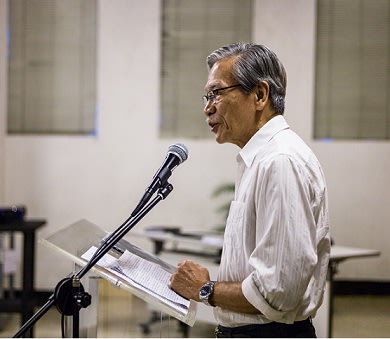
Inquirer Publisher Raul Pangalangan receives award in behalf of Elizabeth Lolarga
This year's awardees were Ina Alleco Silverio of Bulatlat.com for her online story, "Three months after Sendong, Iligan residents still far from rebuilding their lives" and Elizabeth Lolarga of the Philippine Daily Inquirer for her print story, "365 political prisoners go on hunger strike".
The works of Silverio and Lolarga were chosen among seven other finalists, four from online and two from print which were all published between October 1, 2011 and October 1, 2012. The winners each received P10,000 and a trophy, funded by the Simbulan-Estella family, and co-presented by the University of the Philippines Department of Journalism and Vera Files.
The Chit Estella Journalism Awards and and the Memorial Lectures that followed awarding ceremonies are intended to keep alive Simbulan's ideals of excellent journalism and human rights advocacy.
Simbulan, better known by her byline Chit Estella, died in a vehicular accident May 13 last year on Commonwealth Avenue in Quezon City. She was 53.
Former Bayan Muna Partylist Rep. Satur Ocampo, who was the guest speaker, presented a historical perspective of the human rights situation in the country and its connection with the counter-insurgency campaign of the government."Araw-araw may nangyayaring paglabag sa karapatan, lalo na ng maliliit na mamamayan (Everyday violations of human rights happen, especially to the common man)," he said Satur Ocampo during the memorial lecture of the said awards ceremony at the UP College of Mass Communication Auditorium.
A journalist with the old Manila Times before the declaration of Martial Law in 1971,Ocampo spent many years in the underground movement and as a political prisoner. He now writes a column for the Philippine Star.
Human Rights Commissioner Cecilia "Coco" Quisumbing acknowledged the vital role of the media in stopping human rights violations. She enjoined media to " stay away from press release journalism" and do more research in doing reports.
Estella's husband, UP Prof. Roland Simbulan, said Chit's death has led him to another advocacy: road safety. He now heads a group called Families of Road Victims and Survivors, basically a support group but is also working on making roads in the country safe.
(VERA Files is put out by veteran journalists taking a deeper look at current issues. Vera is Latin for "true.")
Source: http://ph.news.yahoo.com/blogs/the-inbox/lolarga-silverio-win-1st-chit-estella-awards-040456299.html;_ylt=AqYvQQnvinXnHILHpIj.QmPhV8d_;_ylu=X3oDMTFnZmkyMjJyBG1pdANCbG9nIEluZGV4IGJ5IEJsb2cEcG9zAzEwBHNlYwNNZWRpYUJsb2dJbmRleA--;_ylg=X3oDMTFpYWhhajZmBGludGwDcGgEbGFuZwNlbi1waARwc3RhaWQDBHBzdGNhdANibG9nBHB0A3NlY3Rpb25z;_ylv=3#more-id
Subscribe to:
Posts (Atom)