Oliver Salonga in concert last night at the Ayala Museum lobby. He began with something very modern or 20th century (it had atonal and dissonant qualities), Samuel Barber's Piano Sonata in E-flat Minor, Op. 26, then moved without a break to Rachmaninoff's Etude Tableaux, Op. 33 and ended with the more traditional sounds of Franz Liszt's Reminiscences de Norma du Bellini. The Scarlatti sonata that he played as an encore really gripped my heart. It's the sort of music I like to cry along with, but it was a happy night so no tears, except for the thunderstorm that raged outside. Photo by Anna Leah Sarabia
From boy to big man of the piano, we've watched him grow to even teach us how the Rachmaninoff etudes "are not like Chopin etudes that target a specific technique for each etude. The etudes teach you to apply different techniques based on what's written with emphasis on the actual application rather than a mastery of a certain technical device." Photo by Anna Leah Sarabia
Oli triumphant. His friends from his Makiling years still like to call him "Berong," short for Keroberong or a Filipinized version of "Care Bear" because of his chubbiness. He's a graduate of the Philippine High School for the Arts in Laguna. He's winding up his Ph.D. studies in piano performance at the University of Southern California under Norman Krieger. Photo by Anna Leah Sarabia
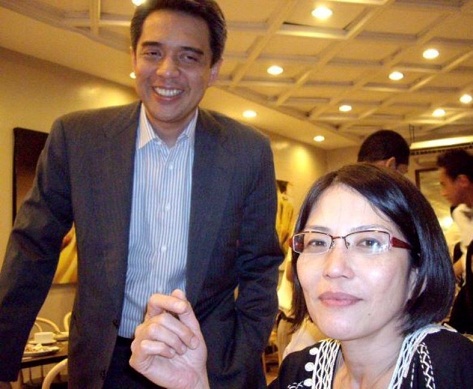
At almost any recital in any venue, an appreciative audience that includes neurosurgeon and art patron Joven Cuanang and sculptor Julie Lluch likes to have a moment with the musical artist to hold his hand or hug him. As an aside, Julie is teaching herself to play the piano after she had her upright at home tuned up. Photo by Babeth Lolarga
"Music speaks what cannot be expressed, soothes the mind and gives it rest, heals the heart and makes it whole, flows from heaven to the soul." - Unknown
"...(M)usicians are willing to give their entire lives to a moment - to that melody, that lyric, that chord, or that interpretation that will stir the audience's soul. Musicians are beings who have tasted life's nectar in that crystal moment when they poured out their creative spirit and touched another's heart. In that instant, they were as close to magic, God, and perfection as anyone could ever be. And in their own hearts, they know that to dedicate oneself to that moment is worth a thousand lifetimes."-David Ackert, Los Angeles Times
The unknown author of that quote and Mr. Ackert I must thank profusely and publicly for giving me a good shove so I can recall in a semi-tranquil mood the times the musical "guns of August" fired and caused a pleasurable trembling in my soul. I've used an Ackert quote in a past blog about pianist Cecile Licad, but I keep coming back to it.
There's almost a "near-suicidal" quality to a true musician's playing. It's in the way they give their all to an elusive moment that will quickly become a memory for the listener unless everything, every nuance of a note or a gesture, is caught in an audio-video recording. Otherwise, there is nothing more exciting, more electrifying than being present in a live performance. Especially if it is someone like Oliver who I first watched at his farewell recital at the then PCIBank's Francisco Santiago Hall in Makati before he first left for his undergrad music studies in the States.
I've seen him at a tertulia at Odette Alcantara's Heritage House in Blue Ridge, Quezon City, where he attempted to do the folk ditty "Pamulinawen" as his encore piece. After repeated mistakes, he apologized and instead played a longer and more difficult Chopin piece. This has led to my impression that Oliver doesn't take the easier path. Gusto niya talagang pahirapan ang kanyang sarili.
And it's good for him. We, the audience, also benefit. I've also watched him play at the Baguio Country Club ballroom, at the former Kiss the Cook Gourmet at UP Village to kick off the Pablo Tariman-initiated Intimate Concert Series, at Abelardo Hall last year and then last night at a museum. Oliver is a life force, indeed, like the backdrop of paintings by Jana Benitez. Unsolicited advice from a concerned tita: Lose some of the weight. It may keep your stamina up.
The pictures tell of my latest experience of him better.
Thanks for putting this recital together, Ray Sison of ROS Music Center, Pablo Tariman of Music News and the Ayala Museum for opening up the lobby space on a Monday and a holiday (yesterday was the advanced celebration of National Heroes Day). Don't ever be discouraged by slight weather disturbances or the challenge of producing and marketing a recital.
When I think of contemporary heroes, politicians never cross my consciousness or my radar. It's always the authentic artists and tireless cultural workers who do. They are the ones who take the greater risks and make a nation truly proud and great. And people like me, a mere music fan, are grateful. Once again, Oliver, bravo!
Showing posts with label Ray Sison. Show all posts
Tuesday, August 26, 2014
Saturday, July 5, 2014
Friday, July 4, 2014
Marc Grauwels charms Manila music lovers
Alma Miclat and her smart phone caught my old pal Al Vicente, retired ambassador, me and other members of the audience at the Ayala Museum in rapt attention at what's going on in front of us...
...Listening to and watching one of Belgium's best exports, the virtuoso flutist Marc Grauwels, lecture with such wit and play with such an entrancing style where he and his instrument dance to the music of the spheres. Thank you, Ray Sison and ROS Music Center, for bringing The Magic Flutist over. Thank you, Corazon Pineda Kabayao, accompanying artist, for adding more chemistry to that Wednesday evening. Photo by Anna Leah Sarabia
Monday, March 18, 2013
Saturday, March 24, 2012
Great pianists need a piano to match their gifts
When Cecile Licad blows into town for concert engagements, it is not egoism on her part when she asks for a piano that will enable her to give her best on concert night.
No one appreciates this more than Ray Sison, principal flutist of the Manila Symphony Orchestra, local producer of some Licad concerts since 2010.
Sison also produced Philippine concerts of Germany’s Rolf-Dieter Arens, France’s Pascal Roge and Laure Favre Kahn, Russia’s Sofya Gulyak, among others.
He says, “Every time we have a concert we learn something new about the preferences of each pianist.”
Sison, who’s behind ROS Music Center that specializes in music development for orchestra and symphonic brands, classical concert productions, acoustic construction and repairs and maintenance, calls pianists ”the most disadvantaged of all instrumentalists because they have to contend with an instrument that is always new to them.”
He says,”Except for Vladimir Horowitz who could bring his own piano and technician with him, most pianists adjust to a piano’s idiosyncrasies. The piano has many adjustments that can be made to it so a high-caliber pianist is used to these adjustments being near perfect. Their music is near perfect. The piano must follow suit.”
To show how important the right piano is, Sison says, “When you tune a guitar, you use an electronic tuner and tune each string perfectly in about two minutes. A piano is more complicated because the higher notes have to be stretched up a bit ever so slightly and the bass notes stretched down. This is because the harmonics of the bass note has to be in tune with the fundamental of the treble note. Sounds complicated? It is.”
The University of the Philippines College of Music plans to introduce piano technology as a subject. He welcomes this, saying, “Pianists can benefit tremendously. They can do first aid themselves to ailing pianos or communicate with their technician on to how to bring out a certain sound they like to have.”
A well-trained piano tuner and technician can make a huge difference.
Sison says, “So crucial is this that the likes of Vladimir Ashkenazy and Horowitz bring their own technician with them. Technicians can bring out the X factor of the piano. A good tuner must not only be in perfect tune, he must keep the piano in tune for a whole night of pounding. He must land the tuning pins so that they are stable. The idea is to tune a little sharper than the target. Let the pin settle into place by making light taps at the tuning hammer.”
It is an openly known that cultural centers depend on the government for funds. They follow the bureaucracy rule of awarding piano purchase or repair to the lowest bidder.
Sison considers this still all right and a necessity in public offices. He says, “The crucial thing is to determine how far you want to fix the piano. Do you want it okay, slightly okay, very okay, good as new? All over the world the standard is good as new.”
He cited the konzerthaus in Vienna that will start to replace ten-year-old pianos, even if in perfect condition.
There are ways to be able to get more concert-level pianos here. He recommends that “we be frank with our sponsors and communicate privately and politely about the state of the pianos every time a pianist plays there.”
Sison said the Cultural Center needs to hear from the pianists adding that there are donors willing to donate a piano or willing to take on the full restoration of the pianos guided by the factory specifications of the brand of the piano.
At the Holy Angel University auditorium in Angeles City, Pampanga, Licad will be heard there for the first time on March 22. The concert is special to Sison. His company built the auditorium.
He says, “The auditorium is very quiet inside. The only thing you will hear is the music. You can try to talk to someone at the back of the hall while you are on stage and understand each other. That’s 20 rows away.”
He has produced concerts with 20 people in the house and jam-packed ones, too, saying, “Fulfillment comes from seeing the pianist smile after and during the concert because the piano was a help, not a liability, from seeing the audience elevated to a certain high after hearing an inspiring concert, and from hearing for myself beautiful music backed by mechanical success brought about by the technician.”
Licad’s other provincial engagements are on March 25 at 5 p.m. at Island Cove Hotel and Leisure Park in Binakayan, Kawit, Cavite, and March 27 at 7:30 p.m. at Marco Polo Plaza Hotel in Cebu City.
May there be pianos worthy of her in all those places. -- Elizabeth Lolarga
Originally published in Vera Files/Yahoo Philippines, March 19, 2011
Photo courtesy of Joshua Ignacio and Elnora Halili
Tuesday, October 19, 2010
Is That You, Monsieur Chopin?
This genius of his age once exhorted, "Put all your soul into it, play the way you feel!"
But I never encountered a more cerebral classical pianist than the Frenchman Pascal Rogé. His program of "Chopin and French Impressionism" at the Philamlife Auditorium last night was performed the way a deeply knowledgeable curator would guide you through a history of period music by Fauré, Poulenc, Ravel and yes, the man whose bicentennial is being celebrated this year, the Polish musician who conquered France and the rest of Europe, who prematurely died of tuberculosis and whose heart is buried in his homeland and in all who continue to cherish his music.
Perhaps Rogé has nothing more to prove. He wasn't there to dazzle or impress us with fiery techniques; he is past that. When this ruggedly handsome performer strode onstage, he acquired the demeanor of a professor as he put on his glasses and played non-stop for at least an hour the nocturnes, valses, mazurkas and etudes of the composers earlier cited. No pause at all to acknowledge appreciative applause although there were one or two audience members who couldn't contain themselves.
We had to refrain from clapping after each piece as his interpretation seemed to be meant as one whole seamless piece where he tried to show us the differences and the likenesses of the composers of that period. All that was lacking was the voice-over of a lecture.
And always in the first and second parts of his program, Rogé closed with a Chopin piece as though to put the exclamation point to an entire periodic sentence running into several pages. In the second set of pieces, he alternated Debussy and Chopin till it was hard to tell them apart until you catch a familiar passage.
Nonetheless, Chopin's agony and ecstasy were evoked as were the suggestions of water Debussy unfailingly makes (to me, his is water music: waves licking shore, veils of waterfall, rain splattering on pavement and stones).
Retired music reviewer Anna Leah Sarabia, who still frequents concert halls, said in recognizing Chopin's genius and his embodying the spirit of his age, "He had the capacity to create monumental structures out of so much passion and tension. From them emerged exquisite treasures."
Rogé gave in to the two standing ovations the audience of a few hundred gave him with the piece (our personal favorite and the one I wished aloud he'd play) "Gymnopedie" by Erik Satie. This composer, dismissed in his time as clumsy and repetitive, had no qualms of calling his pieces furniture music, something best played as background to other activities. Well, it is the music I will specify in my living will as the one to be repetitively played till I breathe my last.
To Rogé we owe gratitude for playing against what producer Ray Sison described as "all odds of the storm landing in Manila. He will brave it and so will hundreds of us! I heard him this weekend in Hong Kong, and he means every note that comes out of his fingers."
Our next fervent wish is to hear Rogé again, this time playing four hands with his life partner Ami
Mr. Sison and all supporters/producers of live classical music concerts, are you listening?
Rogé signs diary of delighted fan. Photo by ANNA LEAH SARABIA
But I never encountered a more cerebral classical pianist than the Frenchman Pascal Rogé. His program of "Chopin and French Impressionism" at the Philamlife Auditorium last night was performed the way a deeply knowledgeable curator would guide you through a history of period music by Fauré, Poulenc, Ravel and yes, the man whose bicentennial is being celebrated this year, the Polish musician who conquered France and the rest of Europe, who prematurely died of tuberculosis and whose heart is buried in his homeland and in all who continue to cherish his music.
Perhaps Rogé has nothing more to prove. He wasn't there to dazzle or impress us with fiery techniques; he is past that. When this ruggedly handsome performer strode onstage, he acquired the demeanor of a professor as he put on his glasses and played non-stop for at least an hour the nocturnes, valses, mazurkas and etudes of the composers earlier cited. No pause at all to acknowledge appreciative applause although there were one or two audience members who couldn't contain themselves.
We had to refrain from clapping after each piece as his interpretation seemed to be meant as one whole seamless piece where he tried to show us the differences and the likenesses of the composers of that period. All that was lacking was the voice-over of a lecture.
And always in the first and second parts of his program, Rogé closed with a Chopin piece as though to put the exclamation point to an entire periodic sentence running into several pages. In the second set of pieces, he alternated Debussy and Chopin till it was hard to tell them apart until you catch a familiar passage.
Nonetheless, Chopin's agony and ecstasy were evoked as were the suggestions of water Debussy unfailingly makes (to me, his is water music: waves licking shore, veils of waterfall, rain splattering on pavement and stones).
Retired music reviewer Anna Leah Sarabia, who still frequents concert halls, said in recognizing Chopin's genius and his embodying the spirit of his age, "He had the capacity to create monumental structures out of so much passion and tension. From them emerged exquisite treasures."
Rogé gave in to the two standing ovations the audience of a few hundred gave him with the piece (our personal favorite and the one I wished aloud he'd play) "Gymnopedie" by Erik Satie. This composer, dismissed in his time as clumsy and repetitive, had no qualms of calling his pieces furniture music, something best played as background to other activities. Well, it is the music I will specify in my living will as the one to be repetitively played till I breathe my last.
To Rogé we owe gratitude for playing against what producer Ray Sison described as "all odds of the storm landing in Manila. He will brave it and so will hundreds of us! I heard him this weekend in Hong Kong, and he means every note that comes out of his fingers."
Our next fervent wish is to hear Rogé again, this time playing four hands with his life partner Ami
Mr. Sison and all supporters/producers of live classical music concerts, are you listening?
Rogé signs diary of delighted fan. Photo by ANNA LEAH SARABIA
Friday, October 15, 2010
A Night with a Russian
Arriving a few minutes late, Anna Leah and I found the entrance to the Philamlife auditorium firmly shut, and the security guard refused to give an inch even as the performer, Sofya Gulyak, was already moving swiftly to her second piece, Chopin's Polonaise Fantasie in A-flat, op. 61 with hardly a pause after the Mazurkas.
We learned later that she did wait for a few seconds for the expected applause after the first piece (it would have been the cue for latecomers like us to sneak in). It didn't come, leaving her with this puzzled look but she went on with the next piece.
Although physically heavyset with a distracting tendency to take brief pauses to wave aside an errant strand of curly hair from her face, pull down her black blouse or tug at her sleeve, Gulyak showed capacities for powerful hand work in the passages that called for thundering fortes and fortissimos and delicacy, especially in her interpretation of Schumann's Abegg Variations, Kinderscenen and Carnaval.
We've often wondered why Manila remains in the radar of world-class classical musicians, considering there's a lot of marketing and promotion still to be done to fill up concert halls. In conversations with writer Pablo Tariman, I shared my observations how I see the same people at concerts, and they're mainly seniors, some with domestic helpers assisting them; they come in wheelchairs or hobble with the aid of canes or walkers.
Wonder no more. Filipinos know how to ovate to recognize an excellent performance. Last night, there were shouts of "Bellisima!", not just non-stop clapping, standing ovations and cries of "More." My teacher, Nieves Epistola, used to compare Filipino and Japanese audiences. She noticed that Japanese music students were notorious for bringing in music sheets of the pieces to be played at the concert and study the pages, trying to see if the performer missed some notes. She said they wanted to get their money's worth. Pinoys are kind in comparison.
Producer Ray Sison of ROS Music Center is an example of kindness. After the applause fades and people rise to leave, he always enjoins the audience to go up the stage to meet the artist. Normally, admirers who want their programs signed or pictures taken with the performer go backstage.
Up close Sofya's pudgy, awkward appearance dissipates to show a milk-complexioned, youthful woman who looks like she is just on her junior year at the conservatory. She is on the early side of 30 but already her accomplishments include being the first woman to win the Leeds International Piano Competition on its 16th year in '09.
I feel so blessed the past few months to have watched and listened to the likes of Sofya, Albert Tiu, Qin Li Wei, Arthur Espiritu, who wears the crown of "Prince of Cantabile" placed on his head by Pablo. On Monday, Oct. 18, another seasoned pianist, Pascal Roge will be here for a night of Chopin and French Impressionism. Lined up in the program are 18 pieces by Faure, Chopin, Debussy, Ravel and Poulenc.
This time, I have no more reason to be tardy as I have a gut feeling that we might have a full house.
Photo by Anna Leah Sarabia of blogger shaking pianist Sofya Gulyak's hand
Monday, June 14, 2010
Pianist Oliver Salonga at Kiss the Cook Gourmet

Many things happen when the moon is waxing. It is a good time to dream and set dreams in motion.
On Independence Day, like-minded people got together for twin events: the formal opening of Kiss the Cook Gourmet (KTCG), a restaurant, deli and alternative art space in one, and the inaugural exhibition "Moonlight and Water." The simultaneous solo shows feature the works of Norman Chow, Merci Dulawan, Baboo Mondoñedo and this, uhm...whatever.
As the party got underway, Ray Sison, principal flutist of the Manila Symphony Orchestra, observed that the venue was suitable for evenings of classical music. This after the warm reception for his interpretation of a short repertoire of the masters' music that suited the exhibit theme: Chopin's Nocturne, Mozart's A Little Night Music and Debussy's Clair de Lune with Saint Saens' The Swan from Carnival of the Animals for his encore.
The dreaming went on, with Mia Protacio, lighting designer by day, "poorest" patroness of the arts by afternoon and evening, giving her few centavos' worth--how young operatic singers needed exposure, too, in any venue, wherever there is an audience, new, old, in between still capable of being moved. She is a board member of the Philippine Opera Foundation.
By late evening, as original guests drifted off and a fresh bunch of diners came in, the dream took hold. Today, Ray texted: "It is a dream. But true." KTCG's Waya Araos texted: "Go for gold!" And Pablo Tariman, whose heroism in his classical music advocacy never wavered, announced that the tickets and flyers were on their way. And the event, you ask?
Oliver Salonga, two-time first prize winner of the National Music Competition for Young Artists (NAMCYA), will open KTCG's Intimate Concert Series with a piano recital on July 4 at 6 p.m. at the restaurant-cum-alternative art space (65 Maginhawa st., UP Village, Quezon City).
His program includes: Mozart's 12 Variations on Ah! Vouz Derai Je, K. 265 and Piano Sonata No. 10 in C Major, K.330, Chopin's Sonata No. 2 in B Flat Minor, Op. 35, and Prokofiev's Piano Sonata No. 7 in B-flat Major, Op. 83.
A master of music in piano performance at the Cleveland Institute of Music under the guidance of 2001 Van Cliburn silver medalist, Antonio Pompa-Baldi, Salonga was awarded the Sadie Zellen Piano Prize for his superior musical talent. Under Pompa-Baldi’s tutelage, he won the gold medal in the 2008 Joenju International Piano Competition in South Korea. He is on his summer break from studies at the Cleveland Institute of Music where he is an artist diploma candidate.
Salonga debuted with the Philippine Philharmonic Orchestra under the baton of Ruggero Barbieri. A critic wrote of his rendition of the Grieg concerto: “A dazzling pianist… The distinctive phrasing, the brio, the sense of drama made the piece sound fresh and yes, even contemporary.”
The pianist was a soloist in Rachmaninoff Piano Concerto No.2 in C Minor with the Sydney Symphony Orchestra under George Ellis and got a standing ovation. He was soloist in Liszt’s Piano Concerto No.2 in A major with the Lynn University Philharmonia under the baton of Albert George Schram. He performed the same concerto with the Manila Philharmonic Orchestra under the baton of Rodel Colmenar and received rousing cheers.
The dinner concert, produced by KTCG, Bösendorfer and Music News & Features, will benefit Vest Foundation which, among other missions, aids the continued education of Aeta children in Barangay Bayan-bayanan, Dinalupihan, Bataan.
Limited seats of 60. Tickets at P1,200 each inclusive of dinner. For reservations, call 7484152, 3573811 or text 0906-510-4270.
Photo from Salonga's Facebook
Subscribe to:
Posts (Atom)