Showing posts with label Corregidor Island. Show all posts

Tuesday, April 10, 2012

Rediscovering Corregidor, the brave little island


IT is the island fortress where the blood of Filipino, American and Japanese soldiers was spilled, all of them convinced it was for a cause bigger than them.
Visitors who choose Corregidor as a summer destination this year will find many other reminders of its place in history from the time the Spaniards set it up as a correctional institution for prisoners doing hard labor to the time coastal inspectors or correctors were stationed there to check if ships entering Manila Bay had the proper papers all the way to this era when it has become a living museum.

Situated between Cavite and Bataan, the  island, also known as the “The Rock”, because its rocky landscape, has often been mistaken as part of the latter province because its original name was Isla de Mariveles. It is actually part of Cavite.

With Sun Cruise tours in place and when the waters are not choppy and storm signals are not raised, Corregidor has more to offer than three decades ago.

Once tourists get off the wharf on the lowest level of the isle, also called Bottom Side, they can board the open-sided tranvia that sits 35 people inside.  The fleet of tranvia, replica of the original trams, is a reminder that the island once had 13 miles of railway. The pseudo-trams are really mini-buses.
Tour guide Jose Baja runs through the entire history of Corregidor as the tranvia slowly makes its way to the highest site, sometimes called Swiss site, too, with some 10-15-minute pit stops along the way for picture-taking and a walk around some ruins like bombed-out craters that are cordoned off.

The Swiss site is where surviving Japanese soldiers who did not want to be caught by returning Americans near the end of World War II jumped to their deaths “in the way of the warriors,” Baja says.

Before the war, there were five communities of civilians living on the island in Barrio Lourdes, including Chinese-Filipinos who supplied the groceries. Today there are no permanent residents. Island employees and vendors go home to any of the nearby provinces or Metro Manila.

The American colonial masters spent $150 million to fortify the 900-hectare island whose mission then was to deny the enemy entry to Manila to the extent that their soldiers were required not to surrender.

The stops include Battery Way, a cannon that could then be fired in any direction and hit a target eight miles away. It was the last big gun to be fired before the Americans surrendered to the Japanese.

Baja says the silent Battery Hearn, named after a US corps commander, had a longer radius (17 miles). It was the most publicized at the time, the spot where Japanese soldiers posed and cried, “Banzai!” to show they had conquered the Philippines.

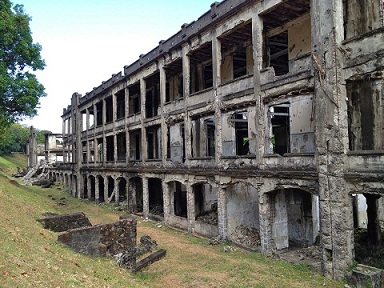
At the Top Side, the ruins of the mile-long barracks can be found. The parade grounds and golf course there was where 1,300 paratroopers landed to liberate the island although the Americans caused the most destruction during Liberation.

Baja says before the Japanese invasion, Cine Corregidor was “the best movie house in the Philippines.” The last movie shown, a foreboding of what was to come, was Gone with the Wind.

The white Pacific War Memorial that resembles a parachute commemorates soldiers who died in the battle for the island. The museum displays, among others, a Coke bottle, broken china, a mosaic of the war’s Pacific Ocean areas, money bills and coins from the American and Japanese periods, the first US flag hoisted on the island (that flag had only 45 stars), spent mortars, a soldier’s goggles.

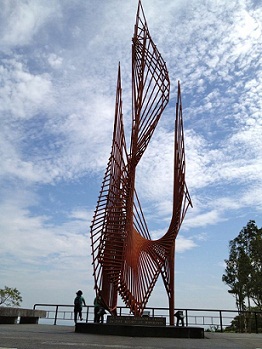
Outside a towering sculpture in orange, an abstraction of the eternal flame, has these words carved on stone: “To live in freedom’s light is the right of mankind.”

Baja says Japan’s timetable of conquest was delayed because Filipinos put up a good fight. Six years ago, the widow of Lt. Norman Reyes, who read the announcement over the Voice of Freedom that “Bataan has fallen,” requested that her husband’s ashes be scattered in the lawn behind the flame.

The Filipino Heroes Memorial depicts revolts throughout Philippine history. It includes the statue of a Filipino peasant who is a guerrilla in disguise. The Spanish Museum recreates a tiny pueblo with 60 steps leading to a lighthouse. The Japanese Memorial, opened in 1991, perhaps a work in progress, has a traditional Oriental arch and a few display cases showing wartime Japanese bills and coins.

A must-stop is “The Malinta Experience,” billed as National Artist Lamberto Avellana’s “final tribute to valor, peace and international understanding.” The diorama of sound and light recreates how the tunnel was used as storage facility, then later served as subterranean shelter as the Japanese closed in.

Baja assures visitors that storied Corregidor does not harbor ghosts, adding, “They are all at peace.”--Elizabeth Lolarga

First published by Vera Files/Yahoo Philippines, April 3, 2012
Photos from top show: ruins of barracks, sculpture of eternal flame and tourists enjoying tranvia ride. All photos by MILA D. AGUILAR


Tuesday, March 13, 2012

Scholars get real

Teens and young adults somersaulting on a field of grass with a view of Manila Bay in the background may not be a special sight, considering how energetic they can be.

It only touches the core of a spectator when one realizes that they live in urban communities so blighted that the available open space they have is a barangay basketball court, if there’s one at all.
During their first cruise to Corregidor Island, high school and college scholars of Real Life Foundation visited historic sites, felt the wind on their faces, breathed fresh air, laughed loudly and freely and shared some of their stories.

Wearing a T-shirt with the message “Helping others never goes out of style,” Jonathan Bacor, 22, a civil engineering major at the Technological Institute of the Philippines, is the son of a tailor and a fulltime homemaker.

His family is one where a child, in this case Jonathan, had to stop schooling for a year or two to let an older sister finish a course first. This meant he had to work in a fast-food crew to help pay the house rent. He was also part-time tutor in math and Kumon.

Around this time, Victory Christian Fellowship, a church group to which he belonged, was searching for scholars for Real Life Foundation. To qualify for a scholarship, the combined monthly family income has to be less than P10,000. Bacor’s grades in public high school, where he graduated fifth honorable mention among a thousand-plus students, qualified him for full tuition and allowance.

Unlike other scholarships that take care of tuition and other fees, Real Life invests in character development. Scholars are coached in leadership, integrity, faith and excellence (thus the acronym LIFE).

Bacor said: “It’s not all about keeping your grades high or being in the dean’s list to avail of an allowance. Our mentor checks on how we do both in school and at home. She observes how I deal with others, how I handle personal relationships.”


The scholars are not tied down to the foundation after they graduate, but they’re encouraged to pay it later. They’re helped in their search for a job that suits their educational attainment.

Sony de la Calzada, Real Life director of partner relations, said the foundation is “not just about giving but partnering with us to change a life.”

“We can’t change the world, but if you start with one, you make a difference in the life of a person,” de la Calzada explained. “That person can create an impact on his/her relatives. Three generations down the road, who can tell what that person is going to be, perhaps a congressman or a senator?”

She continued: “A scholar who finishes college is motivated to get out of the poverty cycle without forgetting his/her roots. They must confront the roots so they can improve the community. The foundation is there to help these kids fulfill their destiny.”

The foundation has graduated 200 high school and college scholars since 2003, no small feat considering how, de la Calzada said, “the longer one keeps a student in school, the greater the possibility of the poverty level going down.”

The coaches give monthly training in good critical thinking, realizing one’s purpose in life, and resume writing, among many practical life skills. They give the kids a safe space where they open up about their hopes and dreams for their families.

De la Calzada added: “Attention is also love. You can give them money and education, but if you don’t give them love, they won’t thrive. This program cares for a person. Even if a parent behaves in a dysfunctional way, the child is still taught to respect the parent.”

Elaine Quindato, 17, openly said she’s a foster child with four grandmothers (all sisters) as guardians. Her biological mother gave her up because she could not afford to raise the baby. The child spent her formative years in Negros Occidental and moved to Metro Manila where she became an honor student at Balara High School, Quezon City.

In 2004, she met her real mother in Cavite where she works as a market vendor. There were tears but no upset of the status quo.

Forward-looking Quindato continues her studies at the National University as a secondary education major.

She said: “I realized I had the gift for teaching in high school on Student Teachers’ Week. Every time there was a chance to replace the teacher, I taught with a passion. I like to give my all even if it tires me.”

As another school year draws to a close, each scholar is encouraged to be grateful to life and its gift of hope.--Elizabeth Lolarga

Photos of the Real Life Foundation scholars having fun and Sony de la Calzada by MILA D. AGUILAR

Originally published in Vera Files/Yahoo Philippines, March 5, 2012