

Brookside Baby
Showing posts with label Mila D. Aguilar. Show all posts
Showing posts with label Mila D. Aguilar. Show all posts
Sunday, January 30, 2022
The summer of '68


Sunday, May 8, 2016
The times of Mommy's life
The best Mother's Day gift I received arrived in my email yesterday, a lengthy letter from my second-born daughter Ida detailing how her class of 21 nursery students prepared for their own tribute to moms. She clinched her letter with what I'd call an "Ida-ism": "happy mother's day, nanay! you make my eyes roll and you may not be my favourite person, but i love you."
 Gliceria "Nene" Dula as a debutante in 1946
 Holding her second-born child, my sister Evelyn Marie ("Embeng")
My own Mommy made my eyes roll not just a thousand times. Among my sisters we like to joke that of her physical traits, Mom bequeathed us her indio nose and her bunions that make closed shoes uncomfortable.
Our clashes were bitter wars of attrition with periods of peace, with the intercession of Daddy, during mealtimes and occasions like birthdays and Christmas. There was a period in adolescence when I opted to stay home rather than be seen with Mom and her growing brood (a devout Catholic, she followed papal edicts to the letter and refused artificial contraceptives). Alone I cherished the relief from her nagging and what I felt was her overbearing presence.
I longed for a mother who could be a friend and confidante the way my Lola Purang in Baguio was to her children and grandchildren, or the way Aunties Fe and Pacing (my father's sisters) were to my cousins. What I felt the Lord had burdened me with was a battleaxe in a slender and attractive package.
One of my sisters still has this image of Mom with a fly swatter ready to swat not just flies but any erring child. The fanny was her target. I have memories of Mom chasing a sister round and round the round dining table with a flyswatter in her right hand. We knew what kamay na bakal meant early on.
I was only able to say what was in my heart to my mother through a letter when I approached my 60s. The letter wasn't even penned by me. It was written for me by former Baguio Writers Group president Luchie Maranan when BWG had a commissioned handwritten letter campaign in February 2015. I supplied the ghost writer with the inputs on what I had been meaning to tell my mother, among which was how I appreciated her sacrifices for the eight children she bore even if this meant a lack of quality time for us since she and Daddy had to go out and work to provide for us. When I finally held Luchie's letter, the hair on my arms stood up. Her penmanship uncannily resembled Mom's, and my first thought was, "Why is Mommy writing me a letter through the BWG?"
 Baguio still means happy memories to us. It was where our parents brought us in the summer, and it must have cost them a pretty penny to do so. Thank you, Dad and Mom!
 The mellowing of Mom came with the coming of the grandchildren. Her oldest apo Carlo's Matchbox collection is courtesy of his Lola Mommy, who spoiled him to pieces.
 This is what I mean by Mom's makuha ka sa tingin facial expression captured by poet Mila D. Aguilar during an intimate concert at Balay Kalinaw organized by Pablo A. Tariman.
Anyway, when Mom read "my" letter, she told my daughter and sisters that even late in the day, I had come to realize why she was the way she was--her sternness, her disciplinarian's ways. By becoming a mother myself, I have seen that motherhood is the toughest job in the world. And that the fretting over one's children and their well-being, even if they're already adults, never ever stops.
My mom was a proud and vain woman, ramrod straight in posture, always well turned out, fully made up whenever she left the house, whether for the office (she worked until her 70s) or a Legion of Mary meeting. An illness crept up on her late last year. Today she is a ghost of her former self, but to me she is even more beautiful as peace slowly descends on her. She mumbles in that state between wakefulness and sleep--I try to decode what she says in hopes I get clues to her past which she has always been reticent to share, except for the good times. Her knees buckle when she tries to stand with assistance from hefty adults.
But our faith teaches us hope--miracles are possible. If her body and mind don't heal fully, my siblings and I plus those who fondly call her Auntie/Tita Nene or Mommy Lolarga (from the streetsweepers she has befriended to the village security guards she sends merienda to) pray that her spirit does, ready to return to the source of Light and Love. And when Judgment Day comes, she will be restored to full glory. This we all believe.
 Guess who has the biggest smile in a family picture from one Christmas in the 1990s? That's our Mom, vibrant in red and seated second from right.


My own Mommy made my eyes roll not just a thousand times. Among my sisters we like to joke that of her physical traits, Mom bequeathed us her indio nose and her bunions that make closed shoes uncomfortable.
Our clashes were bitter wars of attrition with periods of peace, with the intercession of Daddy, during mealtimes and occasions like birthdays and Christmas. There was a period in adolescence when I opted to stay home rather than be seen with Mom and her growing brood (a devout Catholic, she followed papal edicts to the letter and refused artificial contraceptives). Alone I cherished the relief from her nagging and what I felt was her overbearing presence.
I longed for a mother who could be a friend and confidante the way my Lola Purang in Baguio was to her children and grandchildren, or the way Aunties Fe and Pacing (my father's sisters) were to my cousins. What I felt the Lord had burdened me with was a battleaxe in a slender and attractive package.
One of my sisters still has this image of Mom with a fly swatter ready to swat not just flies but any erring child. The fanny was her target. I have memories of Mom chasing a sister round and round the round dining table with a flyswatter in her right hand. We knew what kamay na bakal meant early on.
I was only able to say what was in my heart to my mother through a letter when I approached my 60s. The letter wasn't even penned by me. It was written for me by former Baguio Writers Group president Luchie Maranan when BWG had a commissioned handwritten letter campaign in February 2015. I supplied the ghost writer with the inputs on what I had been meaning to tell my mother, among which was how I appreciated her sacrifices for the eight children she bore even if this meant a lack of quality time for us since she and Daddy had to go out and work to provide for us. When I finally held Luchie's letter, the hair on my arms stood up. Her penmanship uncannily resembled Mom's, and my first thought was, "Why is Mommy writing me a letter through the BWG?"


Anyway, when Mom read "my" letter, she told my daughter and sisters that even late in the day, I had come to realize why she was the way she was--her sternness, her disciplinarian's ways. By becoming a mother myself, I have seen that motherhood is the toughest job in the world. And that the fretting over one's children and their well-being, even if they're already adults, never ever stops.
My mom was a proud and vain woman, ramrod straight in posture, always well turned out, fully made up whenever she left the house, whether for the office (she worked until her 70s) or a Legion of Mary meeting. An illness crept up on her late last year. Today she is a ghost of her former self, but to me she is even more beautiful as peace slowly descends on her. She mumbles in that state between wakefulness and sleep--I try to decode what she says in hopes I get clues to her past which she has always been reticent to share, except for the good times. Her knees buckle when she tries to stand with assistance from hefty adults.
But our faith teaches us hope--miracles are possible. If her body and mind don't heal fully, my siblings and I plus those who fondly call her Auntie/Tita Nene or Mommy Lolarga (from the streetsweepers she has befriended to the village security guards she sends merienda to) pray that her spirit does, ready to return to the source of Light and Love. And when Judgment Day comes, she will be restored to full glory. This we all believe.

Monday, February 23, 2015
Salute to their comrade professor

Dr. Elmer A. Ordoñez’s influence on his students extends widely. That’s how an ideal and effective professor should be.
Although retired from teaching, he remains a literary scholar and a prolific writer. His latest book is also his first novel, Snows of Yesteryear (University of the Philippines Press).
He told the blogger: “I keep track of the output of every generation following mine. I’m not limited to creative writing. I am open to other forms of discourse and categories of writing produced in the various contexts of the times.”
In the ’60s he immersed himself in the works of committed writers and those produced in the writers’ workshops at the UP and Silliman University. He observed, “In the ’70s there emerged alternative forms–resistance literature, underground writing, literature of refusal–many expressed in forthright language in underground publications, some in veiled forms such as allegory like Pete Lacaba’s acrostic poem published in above-ground journals. Others were circulated by hand in mimeograph like Hulagpos or Mga Tula ng Rebolusyon.”
He read the works of writers groups like Galian sa Arte at Tula, Philippine Literary Arts Council with its journal Caracoa, Philippine Writers Union with its Siglaya and Mithi. This literary scholar delved into the regional cultural forms such as the isymaling (Samar), baliling (Mindanao), composo (Negros), salidom-ay (Ilocos) that underground writers appropriated. He called all these “emergent writing” or “anti-hegemonic literature.”
While wartime matured his generation, he said of the generations after him and the possibility of social justice being achieved, finally: “Each generation of writers will figure out what oppresses them. Our generation was traumatized by the war or we experienced direct oppression. We knew what we missed–peace and freedom. But the Cold War affected us in another way.”
He noted the “escapist trend in writing. Instead of writing about the war, there was a tendency to look inward. These writers were influenced by the models used by their writing mentors–Joyce’s ‘Araby’ and ‘The Dead,’ Hemingway’s ‘The Killers’ and the stories taught in writers’ workshops. These were tales on self-discovery, disenchantment and disillusion.”
He recalled the question of Wallace Stegner who taught creative writing at Stanford University. In a visit to the Philippines, Stegner asked “Where are the stories about the Huk rebellion, the peasant unrest?”
Ordoñez said, “Our generation was too preoccupied with the craft of fiction and couldn’t be bothered with new hostilities. I shouldn’t generalize, but this was how my generation coped with the Cold War—by turning inward. There are exceptions to be sure.”
Asked who and what he is reading now, he listed Jim Richardson’s Komunista: The Genesis of the PKP 1902-1935, Amelia Lapeña Bonifacio’s Binondo: Once Upon a War, Emmanuel Calairo’s Cavite Sa Digmaan, Luis Teodoro’s Vantage Point and Rizal’s annotated edition of Morga’s Sucesos de Filipinas. He is also rereading Edmund Wilson’s Memoirs of Hecate County.
Four English majors who were his students, then colleagues, at the UP of the ’60s pay him tribute with their memories.
Geraldine C. Maayo, retired professor from the UP School of Labor and Industrial Relations and a fictionist, said Ordoñez “had a gentle disposition, a gentle voice. Everything about him was gentle: the way he walked, the way he lectured. He had just come from Oxford. He was an authority on Joseph Conrad. But we never saw anything in him that suggested that he thought he was and should be recognized as an authority. He always lectured in that gentle voice of his, occasionally smiling. He always had a prepared lecture. He struck me as a respectful man, respectful of everybody and definitely of his students. Also a bit shy.”
She said of him as a writer, “I like the way he writes, what he writes about. We converge in this aspect. We write of things that are very personal to us. We are both nostalgia persons, sentimental persons.”
Poet-novelist Mila D. Aguilar recalled that Ordoñez was her last Research in Comparative Lit professor before she graduated in’69. She had taken too many Humanities subjects and had forgotten about this requirement.
She said, “He gave me a 1.0 (Excellent) and got me to teach at the department the very semester after without my having to get my transcript of records. Elmer was a thorough liberal, kind to a fault. When he got me to teach, together with Charito Ramirez and Gelacio Guillermo, he shoved aside many other applicants who were waiting in the wings. He would not have known that the three instructors he recruited subsequently became radical, if not apparently yet. The ones he shunted were absolute conservatives. As a result, he was labelled a progressive, in fact blamed when the three of us disappeared into the netherworld of the underground.”
Now that she relates to him as a friend, she said, “Elmer is still the same, thoroughly liberal and kind to a fault. He has a wide-ranging view of things, insisting that Emilio Aguinaldo was not a traitor for the simple reason that he listened to the prominent people of Cavite where he lived.”
Yet, she continued, “he can be very truthful. In 2000, I asked for his recommendation for a renewed teaching post in the English department. He correctly stated that though I was creative and all, my weakness was in research. That got me to rethink my life. From then on I became an avid researcher if not in physical libraries, which I still find difficult to access, at least on Google and the Internet.”
Essayist-fictionist Jenny Llaguno described Ordoñez as “the quintessential mentor—was, is and will be ever patient, ever brilliant, ever shy, ever soft-spoken. He has a lodestone of wisdom to share. This has not changed in the thirty years of my relationship with him as a student, editor and friend.”
She noticed that lately “he is not as quick to answer because of hearing impairment. His voice falters before an audience. His hair has turned grey, but these are changes brought on by time and loss. A certain melancholy vis-a-vis a certain smile shades his face, a certain longing, too, for his wife. He taught me how to focus when I got derailed in answering an examination question, how to copyedit/proofread, how to be discursive. He has not really changed.”
Essayist-book artist Delfin Tolentino Jr. of UP Baguio recalled being in Ordoñez’s Modern British Literature class. “I was on my way to getting a flat 1.0 until I flunked a long exam where I attributed a couple of excerpts to the wrong poets. The bluffer was finally caught!”
He continued, “Elmer was the department chair at the time. They were the heady days of activism. We pilloried him for refusing to get involved. His radicalization came later. By that time, we were no longer in touch. When we met again after his exile, his first words to me were: ‘Delfin, I am no longer a wishy-washy liberal!’”—Elizabeth Lolarga
Sunday, February 1, 2015
Elmer's feast

The last day of January 2015 was a double book launch day in different parts of sprawling Metro Manila. There is no longer a sleepy hour in terms of road traffic on EDSA. There was the fiction anthology Fast Food Delivery at Greenbelt 4 Makati City at 3 p.m., then Snows of Yesteryear at Solidaridad Bookshop in Ermita at 5 p.m. By 12 noon in Sison, Pangasinan, where the Victory Bus I was riding in en route to Cubao from Baguio City made a 15-minute pit stop, I decided I'd just head straight to Dr. Ordoñez's launch and buy my copy of Anvil's FFD another day.
I had only one body, which was still in recovery from surgery, and I could only manage an event at a time. It was a wise decision, considering I had my backpack on my back, a walking cane on my left hand, a bag of 40 pieces of brownies and two Mario Parial paintings that my husband Rolly had carefully packed in preparation for a Parial retrospective where they would be included. Eeek! Bag lady forever!
But the gods and goddesses of literary Olympus looked kindly on this traveler. I entered Solidaridad past six and climbed its two flights of stairs to catch Dr. Ordoñez fielding the last two questions from the audience concerning his latest book.
I make it a point to be at friends' book launches. I know the difficulties writers go through in order to write, to support writing, to finish a manuscript and to find a publisher. When others try to inveigle me to be involved in so-called "book projects" with an eye on a launch day, I pull back, decline politely (on rare times, impolitely, if the "client" is over-demanding). A book is a work of love; one's life, one's strife, one's passions and convictions are in it. It cheapens the writer if demands on meeting strict deadlines so a book party can fall on a propitious date are made.
I'm glad for the cool, laidback Prof. Ordoñez. He finished his manuscript, then saw it in printed form after turning a young 85 in December. The good news is he has another book in the back burner. I say, "Bring it on" and "More power to prolific octogenarians!" Thanks for setting such a fine example, sir.
P.S. Puwede bang bumati? Mila D. Aguilar, thank you for seeing me to my door. I love a writing community, especially one that looks out for the members' health and safety.


Friday, March 22, 2013
Mila Aguilar's novel

To find out and to purchase the novel in its Kindle edition, visit www.amazon.com The cover was designed by Grace de Jesus Sievert. Grace also designed the cover of Mila's book of 101 poems, Chronicle of a Life Foretold (available in print edition at Popular Bookstore on Morato and Timog avenues, Quezon City, and Solidaridad Bookshop on P. Faura, Ermita, Manila).
Monday, February 18, 2013

Wednesday, November 28, 2012
Comrade Mila and Sister Mila are one
Her books in the 1970s carried titles like Dare to Struggle, Dare to Win! and The Mass Line (A Second Remoulding), all written under her famous nom de guerre Clarita Roja.
The fact that poet Mila D. Aguilar listed the above in her latest collection of poetry, Chronicle of a Life Foretold: 101 Poems (1995-2003), as among her published works means she doesn't shudder in denial that once she was a fierce activist who fought for radical change. The teacher in her will correct you that she still works for societal and spiritual change. The political is still personal to her.

Her book launching at Popular Bookstore on Timog and Morato avenues, Quezon City, was packed with aging activists who haven't lost their fire and who recounted their time underground with Aguilar.
Carolina "Bobbie" Malay, one of the National Democratic Front
representatives during the peace talks at the time of Cory Aquino's
administration, recalled how she was tasked to break the news to
Aguilar's aged mother that her youngest child had joined the movement.
Mrs. Aguilar was in near hysterics and offered to assassinate dictator
Ferdinand Marcos since she was old and had nothing more to lose so her
daughter could surface and lead a normal life.
Brother Eddie Villanueva, former presidential candidate, said he had
gone through personal changes not unlike what the poet went
through--from a baptized Catholic to an agnostic activist imprisoned for
his political beliefs then back to renewed spirituality. Like her, he
saw how this society could improve its stature by being grounded in
morality and a firm belief in God.
In her essay "Poetry as Faith and Prayer," Lilia Quindoza-Santiago, poet, fictionist and literature professor, lauded Aguilar for treading "a territory that those in our generation would rather forego and leave unspoken. Were the activists in the seventies all atheists?The answer is certainly no. Many of us believed…many of us in the most solitary confines of the struggle whether in the fields or in prison stood by our faith. We knew how to pray and we learned to pray well. That was faith and there is that continuing faith now among many of us. We just don't want to talk about it."
She congratulated Aguilar for being a true poet by choosing "to shake us from our nonchalance."
Theater director Behn Cervantes refused to share his memories of
Aguilar which the guests at the launch did or sing a song the way Becky
Abraham and daughter Astarte did. He stood up to read aloud a poem from
the book that he said reminded him of Juan Ponce Enrile, one of the
architects of martial law who unleashed the dogs of fascism on the
movement. The poem "Do you not see the Devil" reads in part:
Do you not see the Devil
That he can be so handsome too
His mien so full of
Gentle grace…
Ah, but listen to the lies,
Listen to the lies
As he drones on and on…
I am afraid only the good
Can apprehend
The meanness of the mien.
I am afraid only the good
Who have their Christ in tow
Can see what it is
He means to do
With the power he has gotten
Through his graceful
Mien, through his gentle
Meanness.
Becoming a writer had been Aguilar's dream. Her father, an educator, was her model. She said, "He made breakthroughs in mother-tongue-based multilingual education and the community school. He's the father of both. By the time I was nine, he was already a Ramon Magsaysay awardee. In high school, I resolved to become a great writer. That must have arisen from my Core Class, which integrated reading, writing and social science in one teacher. But how does one become a great writer without a great cause? My father had my future tailor-made for me; his nation was the great cause."
In college, Aguilar studied Dostoevsky, Faulkner and Hemingway, and found that one could not become a great writer "unless one is steeped in one's culture and history. College was not enough. Even 13 years underground and one and a half years in prison were not enough. I had to do video documentaries all over the Philippines for a few years, then take Philippine Studies formally and informally as well."
She said, "I finally got it. Without a vision, the people perish! That vision is God's for the people of God, led by the children of God. Poetry is emotion expressed in unified rhythm, imagery and tension. What I cannot express of this vision in poetry, I must express in essay and story. Then pray that God will accept my paeans to Him, my plaints for and in behalf of my people."--Text and photos by Elizabeth Lolarga
Originally published by Vera Files /Yahoo Philippines on Nov. 14, 2012.
The fact that poet Mila D. Aguilar listed the above in her latest collection of poetry, Chronicle of a Life Foretold: 101 Poems (1995-2003), as among her published works means she doesn't shudder in denial that once she was a fierce activist who fought for radical change. The teacher in her will correct you that she still works for societal and spiritual change. The political is still personal to her.

Her book launching at Popular Bookstore on Timog and Morato avenues, Quezon City, was packed with aging activists who haven't lost their fire and who recounted their time underground with Aguilar.
 |
| Mila Aguilar and Bobbie Malay |
 |
| Brother Eddie Villanueva |
In her essay "Poetry as Faith and Prayer," Lilia Quindoza-Santiago, poet, fictionist and literature professor, lauded Aguilar for treading "a territory that those in our generation would rather forego and leave unspoken. Were the activists in the seventies all atheists?The answer is certainly no. Many of us believed…many of us in the most solitary confines of the struggle whether in the fields or in prison stood by our faith. We knew how to pray and we learned to pray well. That was faith and there is that continuing faith now among many of us. We just don't want to talk about it."
She congratulated Aguilar for being a true poet by choosing "to shake us from our nonchalance."
 |
| Astarte and Becky Demetillo sing "Pag-ibig sa Tinubuang Lupa" |
 |
| Behn Cervantes reads "Do you not see the Devil?" |
Do you not see the Devil
That he can be so handsome too
His mien so full of
Gentle grace…
Ah, but listen to the lies,
Listen to the lies
As he drones on and on…
I am afraid only the good
Can apprehend
The meanness of the mien.
I am afraid only the good
Who have their Christ in tow
Can see what it is
He means to do
With the power he has gotten
Through his graceful
Mien, through his gentle
Meanness.
Becoming a writer had been Aguilar's dream. Her father, an educator, was her model. She said, "He made breakthroughs in mother-tongue-based multilingual education and the community school. He's the father of both. By the time I was nine, he was already a Ramon Magsaysay awardee. In high school, I resolved to become a great writer. That must have arisen from my Core Class, which integrated reading, writing and social science in one teacher. But how does one become a great writer without a great cause? My father had my future tailor-made for me; his nation was the great cause."
In college, Aguilar studied Dostoevsky, Faulkner and Hemingway, and found that one could not become a great writer "unless one is steeped in one's culture and history. College was not enough. Even 13 years underground and one and a half years in prison were not enough. I had to do video documentaries all over the Philippines for a few years, then take Philippine Studies formally and informally as well."
She said, "I finally got it. Without a vision, the people perish! That vision is God's for the people of God, led by the children of God. Poetry is emotion expressed in unified rhythm, imagery and tension. What I cannot express of this vision in poetry, I must express in essay and story. Then pray that God will accept my paeans to Him, my plaints for and in behalf of my people."--Text and photos by Elizabeth Lolarga
Originally published by Vera Files /Yahoo Philippines on Nov. 14, 2012.
Sunday, October 14, 2012
'Her pigeons now search the sky'
.jpeg)
Her latest collection of poems Chronicle of a Life Foretold, whose cover was designed by someone both dear to the poet and me, Grace de Jesus-Sievert, is now available at Popular Bookstore on Morato and Timog avenues, Quezon City.
Felicitations, Mila!
Tuesday, April 10, 2012
Rediscovering Corregidor, the brave little island
Visitors who choose Corregidor as a summer destination this year will find many other reminders of its place in history from the time the Spaniards set it up as a correctional institution for prisoners doing hard labor to the time coastal inspectors or correctors were stationed there to check if ships entering Manila Bay had the proper papers all the way to this era when it has become a living museum.
Situated between Cavite and Bataan, the island, also known as the “The Rock”, because its rocky landscape, has often been mistaken as part of the latter province because its original name was Isla de Mariveles. It is actually part of Cavite.
With Sun Cruise tours in place and when the waters are not choppy and storm signals are not raised, Corregidor has more to offer than three decades ago.
Once tourists get off the wharf on the lowest level of the isle, also called Bottom Side, they can board the open-sided tranvia that sits 35 people inside. The fleet of tranvia, replica of the original trams, is a reminder that the island once had 13 miles of railway. The pseudo-trams are really mini-buses.
Tour guide Jose Baja runs through the entire history of Corregidor as the tranvia slowly makes its way to the highest site, sometimes called Swiss site, too, with some 10-15-minute pit stops along the way for picture-taking and a walk around some ruins like bombed-out craters that are cordoned off.
The Swiss site is where surviving Japanese soldiers who did not want to be caught by returning Americans near the end of World War II jumped to their deaths “in the way of the warriors,” Baja says.
Before the war, there were five communities of civilians living on the island in Barrio Lourdes, including Chinese-Filipinos who supplied the groceries. Today there are no permanent residents. Island employees and vendors go home to any of the nearby provinces or Metro Manila.
The American colonial masters spent $150 million to fortify the 900-hectare island whose mission then was to deny the enemy entry to Manila to the extent that their soldiers were required not to surrender.
The stops include Battery Way, a cannon that could then be fired in any direction and hit a target eight miles away. It was the last big gun to be fired before the Americans surrendered to the Japanese.
Baja says the silent Battery Hearn, named after a US corps commander, had a longer radius (17 miles). It was the most publicized at the time, the spot where Japanese soldiers posed and cried, “Banzai!” to show they had conquered the Philippines.
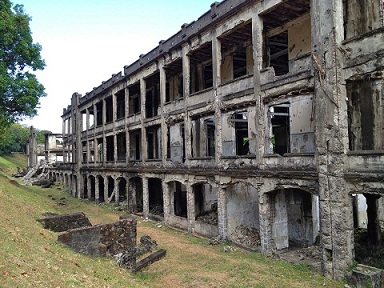
At the Top Side, the ruins of the mile-long barracks can be found. The parade grounds and golf course there was where 1,300 paratroopers landed to liberate the island although the Americans caused the most destruction during Liberation.

Baja says before the Japanese invasion, Cine Corregidor was “the best movie house in the Philippines.” The last movie shown, a foreboding of what was to come, was Gone with the Wind.
The white Pacific War Memorial that resembles a parachute commemorates soldiers who died in the battle for the island. The museum displays, among others, a Coke bottle, broken china, a mosaic of the war’s Pacific Ocean areas, money bills and coins from the American and Japanese periods, the first US flag hoisted on the island (that flag had only 45 stars), spent mortars, a soldier’s goggles.
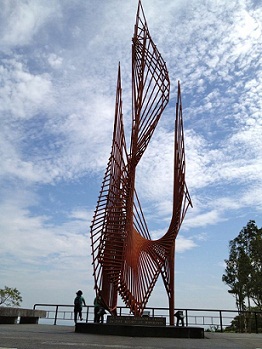
Outside a towering sculpture in orange, an abstraction of the eternal flame, has these words carved on stone: “To live in freedom’s light is the right of mankind.”
Baja says Japan’s timetable of conquest was delayed because Filipinos put up a good fight. Six years ago, the widow of Lt. Norman Reyes, who read the announcement over the Voice of Freedom that “Bataan has fallen,” requested that her husband’s ashes be scattered in the lawn behind the flame.
The Filipino Heroes Memorial depicts revolts throughout Philippine history. It includes the statue of a Filipino peasant who is a guerrilla in disguise. The Spanish Museum recreates a tiny pueblo with 60 steps leading to a lighthouse. The Japanese Memorial, opened in 1991, perhaps a work in progress, has a traditional Oriental arch and a few display cases showing wartime Japanese bills and coins.
A must-stop is “The Malinta Experience,” billed as National Artist Lamberto Avellana’s “final tribute to valor, peace and international understanding.” The diorama of sound and light recreates how the tunnel was used as storage facility, then later served as subterranean shelter as the Japanese closed in.
Baja assures visitors that storied Corregidor does not harbor ghosts, adding, “They are all at peace.”--Elizabeth Lolarga
First published by Vera Files/Yahoo Philippines, April 3, 2012
Photos from top show: ruins of barracks, sculpture of eternal flame and tourists enjoying tranvia ride. All photos by MILA D. AGUILAR
Tuesday, March 13, 2012
Scholars get real
Teens and young adults somersaulting on a field of grass with a view of Manila Bay in the background may not be a special sight, considering how energetic they can be.
It only touches the core of a spectator when one realizes that they live in urban communities so blighted that the available open space they have is a barangay basketball court, if there’s one at all.
 During their first cruise to Corregidor Island, high school and college scholars of Real Life Foundation visited historic sites, felt the wind on their faces, breathed fresh air, laughed loudly and freely and shared some of their stories.
Wearing a T-shirt with the message “Helping others never goes out of style,” Jonathan Bacor, 22, a civil engineering major at the Technological Institute of the Philippines, is the son of a tailor and a fulltime homemaker.
His family is one where a child, in this case Jonathan, had to stop schooling for a year or two to let an older sister finish a course first. This meant he had to work in a fast-food crew to help pay the house rent. He was also part-time tutor in math and Kumon.
Around this time, Victory Christian Fellowship, a church group to which he belonged, was searching for scholars for Real Life Foundation. To qualify for a scholarship, the combined monthly family income has to be less than P10,000. Bacor’s grades in public high school, where he graduated fifth honorable mention among a thousand-plus students, qualified him for full tuition and allowance.
Unlike other scholarships that take care of tuition and other fees, Real Life invests in character development. Scholars are coached in leadership, integrity, faith and excellence (thus the acronym LIFE).
Bacor said: “It’s not all about keeping your grades high or being in the dean’s list to avail of an allowance. Our mentor checks on how we do both in school and at home. She observes how I deal with others, how I handle personal relationships.”

The scholars are not tied down to the foundation after they graduate, but they’re encouraged to pay it later. They’re helped in their search for a job that suits their educational attainment.
Sony de la Calzada, Real Life director of partner relations, said the foundation is “not just about giving but partnering with us to change a life.”
“We can’t change the world, but if you start with one, you make a difference in the life of a person,” de la Calzada explained. “That person can create an impact on his/her relatives. Three generations down the road, who can tell what that person is going to be, perhaps a congressman or a senator?”
She continued: “A scholar who finishes college is motivated to get out of the poverty cycle without forgetting his/her roots. They must confront the roots so they can improve the community. The foundation is there to help these kids fulfill their destiny.”
The foundation has graduated 200 high school and college scholars since 2003, no small feat considering how, de la Calzada said, “the longer one keeps a student in school, the greater the possibility of the poverty level going down.”
The coaches give monthly training in good critical thinking, realizing one’s purpose in life, and resume writing, among many practical life skills. They give the kids a safe space where they open up about their hopes and dreams for their families.
De la Calzada added: “Attention is also love. You can give them money and education, but if you don’t give them love, they won’t thrive. This program cares for a person. Even if a parent behaves in a dysfunctional way, the child is still taught to respect the parent.”
Elaine Quindato, 17, openly said she’s a foster child with four grandmothers (all sisters) as guardians. Her biological mother gave her up because she could not afford to raise the baby. The child spent her formative years in Negros Occidental and moved to Metro Manila where she became an honor student at Balara High School, Quezon City.
In 2004, she met her real mother in Cavite where she works as a market vendor. There were tears but no upset of the status quo.
Forward-looking Quindato continues her studies at the National University as a secondary education major.
She said: “I realized I had the gift for teaching in high school on Student Teachers’ Week. Every time there was a chance to replace the teacher, I taught with a passion. I like to give my all even if it tires me.”
As another school year draws to a close, each scholar is encouraged to be grateful to life and its gift of hope.--Elizabeth Lolarga
Photos of the Real Life Foundation scholars having fun and Sony de la Calzada by MILA D. AGUILAR
Originally published in Vera Files/Yahoo Philippines, March 5, 2012
It only touches the core of a spectator when one realizes that they live in urban communities so blighted that the available open space they have is a barangay basketball court, if there’s one at all.

Wearing a T-shirt with the message “Helping others never goes out of style,” Jonathan Bacor, 22, a civil engineering major at the Technological Institute of the Philippines, is the son of a tailor and a fulltime homemaker.
His family is one where a child, in this case Jonathan, had to stop schooling for a year or two to let an older sister finish a course first. This meant he had to work in a fast-food crew to help pay the house rent. He was also part-time tutor in math and Kumon.
Around this time, Victory Christian Fellowship, a church group to which he belonged, was searching for scholars for Real Life Foundation. To qualify for a scholarship, the combined monthly family income has to be less than P10,000. Bacor’s grades in public high school, where he graduated fifth honorable mention among a thousand-plus students, qualified him for full tuition and allowance.
Unlike other scholarships that take care of tuition and other fees, Real Life invests in character development. Scholars are coached in leadership, integrity, faith and excellence (thus the acronym LIFE).
Bacor said: “It’s not all about keeping your grades high or being in the dean’s list to avail of an allowance. Our mentor checks on how we do both in school and at home. She observes how I deal with others, how I handle personal relationships.”

The scholars are not tied down to the foundation after they graduate, but they’re encouraged to pay it later. They’re helped in their search for a job that suits their educational attainment.
Sony de la Calzada, Real Life director of partner relations, said the foundation is “not just about giving but partnering with us to change a life.”
“We can’t change the world, but if you start with one, you make a difference in the life of a person,” de la Calzada explained. “That person can create an impact on his/her relatives. Three generations down the road, who can tell what that person is going to be, perhaps a congressman or a senator?”
She continued: “A scholar who finishes college is motivated to get out of the poverty cycle without forgetting his/her roots. They must confront the roots so they can improve the community. The foundation is there to help these kids fulfill their destiny.”
The foundation has graduated 200 high school and college scholars since 2003, no small feat considering how, de la Calzada said, “the longer one keeps a student in school, the greater the possibility of the poverty level going down.”
The coaches give monthly training in good critical thinking, realizing one’s purpose in life, and resume writing, among many practical life skills. They give the kids a safe space where they open up about their hopes and dreams for their families.
De la Calzada added: “Attention is also love. You can give them money and education, but if you don’t give them love, they won’t thrive. This program cares for a person. Even if a parent behaves in a dysfunctional way, the child is still taught to respect the parent.”
Elaine Quindato, 17, openly said she’s a foster child with four grandmothers (all sisters) as guardians. Her biological mother gave her up because she could not afford to raise the baby. The child spent her formative years in Negros Occidental and moved to Metro Manila where she became an honor student at Balara High School, Quezon City.
In 2004, she met her real mother in Cavite where she works as a market vendor. There were tears but no upset of the status quo.
Forward-looking Quindato continues her studies at the National University as a secondary education major.
She said: “I realized I had the gift for teaching in high school on Student Teachers’ Week. Every time there was a chance to replace the teacher, I taught with a passion. I like to give my all even if it tires me.”
As another school year draws to a close, each scholar is encouraged to be grateful to life and its gift of hope.--Elizabeth Lolarga
Photos of the Real Life Foundation scholars having fun and Sony de la Calzada by MILA D. AGUILAR
Originally published in Vera Files/Yahoo Philippines, March 5, 2012
Subscribe to:
Posts (Atom)